


Most of society observes Lent, Easter, Christmas, and other holidays not found in the Bible.
What you may not know is that there are specific days the Bible commands man to keep,
days that are very important for anyone who desires True Worship.
Chapter 1:
HOLIDAYS, HOLIDAYS EVERYWHERE
Chapter 2:
FEAST DAYS GIVEN AT MT. SINAI AND BEFORE
Chapter 3:
THE HOLY DAYS THROUGHOUT THE NEW TESTAMENT
Chapter 4:
HOW WE SHOULD KEEP THE FEASTS TODAY
Chapter 5:
WHY ISRAEL WAS TAKEN CAPTIVE: A LESSON FOR US
Chapter 6:
BEGINNING OF MONTHS
Chapter 1: HOLIDAYS, HOLIDAYS EVERYWHERE
Have you ever thought about the many holidays our society observes throughout the year? Where did they originate? Is there any reason to honor them other than the fact that they are listed on our wall calendars?
For 2,000 years Christianity has been leaving a permanent mark on our world by the days it commemorates. Annually we witness millions of sincere people observing Lent, Easter sunrise rituals, Christmas, Thanksgiving, and other popular celebrations. Most assume that these days are holy or sanctioned in the Bible.
Despite their religious connotations, such observances are a time when even banks, offices, and businesses customarily close. So ingrained are these supposed Bible-based days that secular public schools close down for church-promoted holidays like Easter and Christmas.
Then there are holidays with more obviously heathen origins. Most grade schools indulge in days such as Valentines Day and Halloween, teaching profane rituals to impressionable young minds. Paradoxically, many churches have now added these secular days to their calendars and have special activities in celebration.
Secular society aside, we must ask why churches carry out special activities on such observances that have no Biblical justification, and that are even condemned in Scripture.
But what is really puzzling is why most churches recognize only one of the Biblical Feasts, Pentecost, while ignoring the other six, replacing them with man's observances.
A Different Message ls Being Taught
Millions of churchgoers assume that they are being led down the road to salvation. Occasionally, a few who seek to learn the truth for themselves look beyond the nominal teachings of their church and study and search their own Bibles. They are astounded at what they soon discover.
They learn that the Messiah and His disciples kept other days and observed times different from what are presently celebrated by mainstream religion and society. Even the Name of the one they worship on these special occasions has been changed.
Consider this for a moment. All religions in the world had or have a specific name for their deity, like Jupiter, Zeus, Baal, Thor, Dagon, Molech, Mithras, Allah, Buddha, and Vishnu. But churchianity refers to its Mighty One simply by the generic title 'God,' with a capital 'G.' (In the Bible, Satan is also referred to as the god of this world with a small 'g' (2 Cor. 4:4). Where's the distinction when the capital 'G' and small 'g' are pronounced the same?)
Most Christian ministers are quite familiar with the personal Name of the Heavenly Father, "Yahweh," but insist on calling upon Him using the common title. Others, realizing He has a Name, equivocate with "Eternal," or the erroneous "Jehovah," neither of which is His Name.
The popular Hebrew word HalleluYah literally means, "we praise you Yah," (Yah being the short or poetic form of Yahweh as in Psalm 68:4, KJV). Notice: Hallel = praise, u = we (give to you), Jah = Yah.
Many are surprised to learn that the patriarchs and prophets had the short form of Yahweh's Name, Yah, right in their own names: IsaYah (Isaiah), EliYah (Elijah), JeremYah (Jeremiah), ZecharYah (Zechariah), etc. (See any Bible dictionary.)
Seminaries routinely teach the personal Name Yahweh, which is found in today's Bible notes, commentaries, common dictionaries, encyclopedias, and other reference works. Perhaps it is even found in your own home library.
The true Name of the Son is not the Latinized Greek name Jesus. Bible authorities agree that the Savior was from the tribe of Judah, spoke Hebrew, and was never called Jesus in His life. He was the Hebrew, Yahshua, Who said He came in His Father's Name, John 5:43. Notice the first part of His Name, Yah, is the same as His Father's! “Shua” means Salvation; Yahshua is the Salvation of Yah.
We have restored the sacred Name of the Father, Yahweh, and Yahshua His Son in this in-depth study. (More information is available on the proper Names of the Father and Son given to mankind from on High. Read our other mini-studies and in-depth articles on-line.)
Teaching Through Ignorance or by Design
It is most difficult to believe that so many nice, smiling ministers, professedly teaching the Bible, could actually be promoting error. But the Apostle Paul warns of this very thing in his letter of 2 Corinthians 11:14-15, And no marvel; for Satan himself is transformed into an angel of light. Therefore it is no great thing if his ministers also be transformed as the ministers of righteousness; whose end shall be according to their works.
Admittedly, there are those who are ignorant of the deeper truths of the Bible and perhaps are not aware that they are not teaching the whole counsel of Yahweh. But, if one seriously studies this special book, the Bible, which the Creator has given mankind, one will find that it repeatedly contradicts what is commonly taught today.
Teaching error instead of truth is not new. It was being done over 2,000 years ago. Paul told the elders in Ephesus that no sooner would he leave when grievous wolves would enter in among them, not sparing the flock (Acts 20:29). The sheep of Yahweh were led away from the heights of pure worship (2 Thess. 2:7). The same continues today. Jeremiah laments in a prophecy:
My people have been lost sheep: their shepherds have caused them to go astray; they have turned them away on the mountains; they have gone from mountain to hill; they have forgotten their resting place, Jeremiah 50:6.
Just as today, the priests were not concerned with obedience, but merely gave lip service to Yahweh. The people felt that so long as they carried out the customs and rituals they were being taught, the Almighty would accept their efforts. The priests also were lax and allowed the people to worship in their own way. But Ezekiel regrets that the priests (teachers of the Book, the ministers) had not instructed proper worship according to the Bible.
Her priests have violated My law, and have profaned My holy things: they have put no difference between the holy and profane, neither have they showed difference between the unclean and the clean, and have hid their eyes from My Sabbaths, and I am profaned among them, Ezekiel 22:26.
Those who are supposedly teaching the righteousness and holiness of Yahweh have ignored Yahweh's clear, unmistakable commandments and have taught smooth things to please their audience. By doing so they make virtually no distinction between what is proper and holy and what is profane. Not explained is that our sins — our disobedience — separate us from Yahweh so that He will not hear our prayers, John 9:31. Note His words in Isaiah 59:2:
But your iniquities have separated you from your Elohim, and your sins have hidden His face from you so that He will not hear.
As long as the carnal-hearted person ignores Yahweh and His ways and insists upon going his own way, he will hopelessly struggle without help and guidance. Neither will he obtain the blessings from on high. The time is coming, however, when men shall return to the pure worship of their Creator.
And the ransomed of Yahweh shall return, and come to Zion with songs, and everlasting joy upon their heads: they shall obtain joy and gladness; and sorrow and sighing shall flee away, Isaiah 35:10 (see also Isaiah 2:2-4).
Returning to the Old Paths Required
We desire to return to the Word of truth (John 17:17) and learn what the Bible says about proper worship of our Creator. True worship revolves around the days upon which He desires to be worshiped, not on days we think are acceptable. Isaiah 55:8-9 reveals:
For My thoughts are not your thoughts, neither are your ways My ways, says Yahweh. For as the heavens are higher than the earth, so are My ways higher than your ways, and My thoughts than your thoughts.
Yahweh's Word warns us not to trust man for salvation because man can lead us astray:
Thus says Yahweh; “Cursed be the man that trusts in man, and makes flesh his arm, and whose heart departs from Yahweh,” Jeremiah 17:5.
The world's way that may seem to be the correct worship of Yahweh profits us nothing, no matter how sincere we are and no matter how much we want Him to accept our form of worship. Again He says through the prophet Jeremiah:
This evil people, which refuse to hear My words, which walk in the imagination of their heart, and walk after other deities, to serve them and to worship them, shall even be as this waistband, which is good for nothing, Jeremiah13:10.
Proverbs 14:12 reveals that there is a way that seems right to a man but the end thereof is the way of death.
Chapter 2: FEAST DAYS GIVEN AT MT. SINAI, AND BEFORE
The world has been tricked into accepting substitutes, both for the Scriptural Feast Days and for the true Mighty One Himself. Salvation is jeopardized by ignoring His Word and blindly believing the falsification of law and grace.
Most don't care to hear about obedience, but they wholeheartedly agree that if their neighbor would keep the Ten Commandments that this would be a far better world! They admit that the Ten Commandments are important and should be observed by good Christians today. But when reminded of the commandments concerning the Sabbath and His Name, they argue that the Sabbath is Jewish and the Name is for Hebrews. That's not what Scripture says.
The first verse of Exodus 20 reveals that Yahweh was the One Who gave the law. Therefore, it is not the law of Moses or the law of the Jews, but the law of Yahweh. The law is His expressed will for those who will take hold of the covenant of promise.
What's more, millions are ignorant of the fact that more than just the Ten Commandments were given at Sinai. Yahweh's Holy Feast Days were also included in the issuing of His law. Moses is given the Ten Commandments in chapter 20 of Exodus, and he doesn't make his final descent from Mt. Sinai until the end of chapter 34. Before he comes down he receives the command for the Feast Days (Ex. 34:18-22).
These special observances were not intended only for ancient Israel; and, contrary to what many think, they are not exclusively "Jewish." In Leviticus 23:2, Yahweh directs Moses to tell the children of Israel that these are "My Feasts." In verses 4, 37 and 44, we read that these seven annual observances are "Feasts of Yahweh." Furthermore, these Feasts are to be observed as a statute "forever" (Lev. 23:14, 21, 31, and 41). The weekly Sabbath is included in this law. We have yet to come to the end of “forever."
It is clear from the Bible that we can worship in utmost sincerity and with joyful humility, yet do it all for nothing! Unless our worship is in harmony with His Word, the Holy Scriptures, what we do in accordance with man's thinking is an exercise in futility. Our Savior warns the Pharisees, in the words of Isaiah 29:13 and quoted in Mark 7:7:
In vain do they worship Me, teaching for doctrine the commandments of men.
Paul similarly admonishes us in Titus 1:14:
Be sound in the faith, not giving heed to Jewish fables and commandments of men that turn from the truth.
If we call Him by a name other than His personal, revealed Name, Yahweh, by which He wishes to be called, we lack a proper relationship with Him. We can worship on a day that we choose, and find it is useless! He is to be worshiped only on the days He tells us and in a manner He has revealed to us. Anything else is disobedience, once we know the truth.
Yahweh is seeking only those who are willing to make permanent changes in both their worship and their lives in order to please Him. He looks for true, sincere repentance. He can't work with stiff-necked, hard-hearted, unyielding people who insist on doing it their way. Every time ancient Israel rebelled in such a fashion, He punished them. When they obeyed Him, He blessed them. Their example is for us. Now all these things happened unto them [ancient Israel] for examples: and they are written for our admonition... wherefore let him that thinks he stands take heed lest he fall, 1 Corinthians 10:11-12.
Almighty Yahweh makes the rules and we must abide by His rules if we aspire to be in His coming Kingdom. Going our own way and doing only what appeals to us has no value as far as our Creator is concerned.
The Special Sign Between Yahweh and His People
The Bible tells of the special sign that the Almighty Sovereign Yahweh gave to His people. He specifically said that this unique sign would set His true people apart so they would know Him as their Redeemer. This essential sign is also for us to identify, and know with certainty, the true Mighty One of the Bible:
So I caused them to go forth out of the land of Egypt, and brought them into the wilderness. And I gave them My statutes and showed them My judgments, which if a man do, he shall even live in them. Moreover, also I gave them My Sabbaths to be a sign between Me and them, that they might know that I am Yahweh that sanctifies them, Ezekiel 20:10-12 (see also Exodus 31:13).
Yahweh says His Sabbaths (plural, meaning annual as well as weekly) are a sign between Him and His people so that they can know Him as the One Who sanctified Israel (set them apart for a special purpose). This sign of the Sabbath is "forever" (Ex. 31:17). He sanctifies His people today just as He did Israel. In fact, New Testament believers are called "Israel of Yahweh" (Gal. 6:16). Israel's example of obedience and disobedience to His laws is for us to learn from, as we have seen.
The same ancient sign of the Sabbaths applies to obedient believers today, who are indeed, Israel. Paul wrote of his countrymen, Who are Israelites; to whom pertains the adoption, and the glory, and the covenants, and the giving of the law, and the service of Elohim, and the promises, Romans 9:4. Yahweh says He does not change (Mal.3:6). He is calling an obedient people today just as He did anciently.
Holidays or Holy Days?
These same Sabbaths that Yahweh gave to Israel apply to the called-out believers, the Israel of Yahweh, today. The same Mighty One Who delivered Israel out of Egypt is working with His people even now, bringing them out of the Egypt of sin.
He has recorded for us how He delivered His people in the Old Testament. By reading ancient Israel's history we can avoid their mistakes and not rebel against Him as Israel did (Judg. 3:7).
Remember, Israel's main problem was wanting to worship in the manner of the heathen nations around them. They preferred heathen deities and pagan observances over Yahweh’s Sabbaths and Holy Days. Because of their rebellion, they lost out on the promise. If the Scripture makes anything clear, it is that the same applies to us!
Churchianity has adopted its own days to memorialize what it believes are important events in the life of the Savior here on earth. Christmas is erroneously kept as a memorial of His birth, and Easter, to remember His resurrection. But nowhere in Scripture are we commanded to remember the Savior's birth! Nowhere in the Bible do we find a command to celebrate His resurrection! Perpetuating the world's holidays is nowhere condoned in the Bible. Historians freely admit that no one knows for certain just when the Savior was born. It certainly was not in December. Read our in-depth study, The Untold Story of Christmas.
Instead of Sunday, the Savior and the Apostles kept the weekly Sabbath. Instead of Christmas to New Year's and Palm Sunday to Easter Sunday, the Savior and His followers observed Passover to the last day of the Feast of Unleavened Bread and the First day of the Feast of Tabernacles to the Eighth Day, as well as the Days of Pentecost, Trumpets and Atonement. We are told in 1 Peter 2:21 that Yahshua left us an example to follow. Shouldn't we be following the Father's Holy Days of Leviticus 23?
Many are surprised to learn that years after the death of the Messiah, the Apostle Paul was still observing and teaching these same Feast Days given to Israel.
Traditional Error Dies Hard
The holidays that man has added to his worship came ultimately from pagan Babylon. Manuscripts appearing during these times attest to this fact. The Roman church found it easier to convert the pagans, who had been conquered, by allowing the new convert to continue his old heathen ways, celebrating the times and days with which he was accustomed.
Yahweh has definite feelings about bringing in our own worship and dedicating it to Him. He told Israel that when they came into the land of the heathen, they were not to learn their ways or worship (Lev. 18:1-3). The prophet Amos forewarned us of this practice in Amos 5:21-22, where Yahweh tells of His utter rejection of carnal, human worship rites and rituals. The people think they are worshiping the Almighty, but their attitude and worship is all wrong. He abhors man-made feast days, assemblies, and offerings. (Also, see Isaiah 65:11-12).
I hate, I despise your festivals, and I do not savor your gatherings. Though you offer Me burnt offerings and your grain offerings, I will not accept them: neither will I regard your fattened peace offerings, Amos 5:21-22.
These verses were written both for ancient Israel and us as well. Amos 5:18 speaks to that generation having the expectation of the appearance of the Messiah, which certainly is true for our time.
The religionists simply gave new names and new meanings to the old pagan days and ceremonies. This is known as syncretism, a blending of pagan teachings with Bible truth. It is better understood as “baptized paganism.” These pagan days are what have come down to us as the holidays of churchianity. Virtually none of Yahweh's Holy Days are observed as commanded. Instead, the world has found substitutes and thereby perverts the truth.
Today, we live in an advanced, complex society of high technology: rapid transportation, fiber optics, infra-red scanners, intelligent computers, gene manipulation, and many more advances – all mind-boggling to say the least. Yet, with all the multitrillion bits of information in computers and knowledge doubling every year or so, our world still follows and clings to ancient, dark customs in worship. This in spite of discoveries and scholarship confirming the correctness and propriety of Biblical Holy Days.
Sabbath Extends All the Way Back to Creation - and Forward to Salvation
As we study the Bible, we soon realize that the Feast Days memorialize Yahweh's dealing with His chosen people Israel. His explicit reason for having Moses go to Pharaoh was to get His people released from Egypt so that they could be free to serve Him and keep His Feasts (Ex. 5:1; 8:l)
Yahweh's true observances begin with the weekly Sabbath first established back in Genesis after the creation. Genesis 2:1-3 shows that He rested on the seventh day and blessed it, thus establishing the seventh day as a Sacred day of rest.
The Sabbath is the seventh day of the week and has been so from creation. Nowhere was man authorized to change worship to the first day of the week, Sunday. Paul never advocated any changes, either. Had mankind obediently kept the Sabbath, we would not have so many believing the erroneous theory of evolution being taught today. The seventh-day Sabbath was given man to commemorate Yahweh’s creation — and our redemption, through His Messiah. Notice the words of Yahweh as He thundered the Ten Commandments from Mount Sinai and told us to observe the Sabbath:
Remember the Sabbath day to keep it holy. Six days shalt thou labour and do all thy work: But the Seventh day is the Sabbath of Yahweh your Elohim: in it thou shalt not do any work, thou, nor thy son, nor thy daughter, thy manservant, nor thy maidservant, nor thy cattle, nor thy stranger that is within thy gates: for in six days Yahweh made heaven and earth, the sea, and all that in them is, and rested the seventh day: wherefore Yahweh blessed the Sabbath and hallowed it, Exodus 20:8-11.
Some have argued against Yahweh’s Sabbath by saying that they "keep every day holy." By doing so, they mock the Fourth Commandment's injunction to separate the six days of work from the one Holy day of rest. Today, they reject the Law of Yahweh to work on His Sabbath, the most lucrative day of commerce.
The Ten Commandments are repeated in Deuteronomy 5, which is the second giving of the Law to the new generation of Israel. Because of disobedience, those older than 20 at the time of the exodus died as Israel wandered 40 years in the wilderness; and now, Moses was about to die. Yahweh had delivered them from the bondage of Egypt, fed them in the wilderness, gave them water out of the Rock, and brought them to the Promised Land, a metaphor for redemption, the Millennial reign of Messiah.
Whereas Exodus 20:8-11 spoke of Creation, Deuteronomy 5:15, speaks of Salvation. And remember that you were a slave in the land of Egypt, and Yahweh your Elohim brought you out from there by a mighty hand and by an outstretched arm; therefore Yahweh your Elohim commanded you to keep the Sabbath day. Who created the Heavens and the Earth in the Name of Yahweh; and, who provided Salvation for mankind? Yahshua Messiah, the Aleph and the Tau, the Beginning and the End and the First and the Last. Yahshua, indeed, is the Master of the Sabbath. The seventh day is the day Yahweh rested. It also points to His plan of redemption for us as we cease from our labors and enter into His millennial rest.
Replacing Yahweh’s Sabbath with Sunday as a weekly holy gathering means we have turned our backs on our Creator and Redeemer, our Heavenly Father, Almighty Yahweh of the Bible – and His Son. It shows a rejection of His grace.
The seventh day is special to Yahweh and His chosen. It is a day we spend in close communion with Him. The Sabbath comes around every week, and for that reason, the Fourth Commandment is one of the most ignored and broken of all.
Keeping any day other than the seventh is nowhere sanctioned in the Bible. Sunday was brought into churchianity by the influence of pagan sun worshipers who observed "sun-day" in honor of the sun deity. The so-called “Church Fathers” of the Roman church hated anything "Jewish," and were more than happy to accommodate the pagans.
Give Me a Break
Sociologists and physicians recognize that the more technical or demanding one's job is, the higher the level of performance expected. Technicians, scientists, educators, physicians, and other skilled professionals in our complex society are required to take additional training and refresher courses from time to time to maintain a high level of performance. Often in the form of seminars, these programs focus on new information, reinforce skills, and inspire the participants to attain achievement levels while increasing performance.
Yahweh's weekly and annual "refresher courses" have been in existence long before our modern civilization. Yahweh knows man has a tendency to forget his purpose here on earth, and all too often gets deeply absorbed in the things of the world.
Man soon loses sight of why he was born, and neglects why he should be preparing. Concerns of the world eventually consume all human attention when pulled by the many enticing temptations of entertainment, prestige, popularity, materialism, and sinful pleasures.
Many become completely enmeshed in carnal worldliness, their hearts hardened by the deceitfulness of their sins (Heb. 3:12-13).
Yahweh set aside the Sabbath for man to rest and refocus on the true values by spending time studying His Word and reflecting on the purpose of life. Every seventh day Yahweh's people cease from secular activities for a 24-hour period. This rest and reorientation reminds us of our higher spiritual goals. We then redirect our energies and time to be in harmony with our desire to attain that first resurrection.
Some have argued that keeping the Sabbath is a burden and represents "works of the law." What's so burdensome about resting? How can resting for 24 hours be considered "works?"
In His wisdom, our Creator also looked beyond the weekly rest and established additional time periods throughout the year to redirect our paths more closely toward His celestial goals. We can learn much by observing and reflecting on the annual Sabbaths, an important aspect of the New Covenant.
The Holy Days of Leviticus 23: A Survey
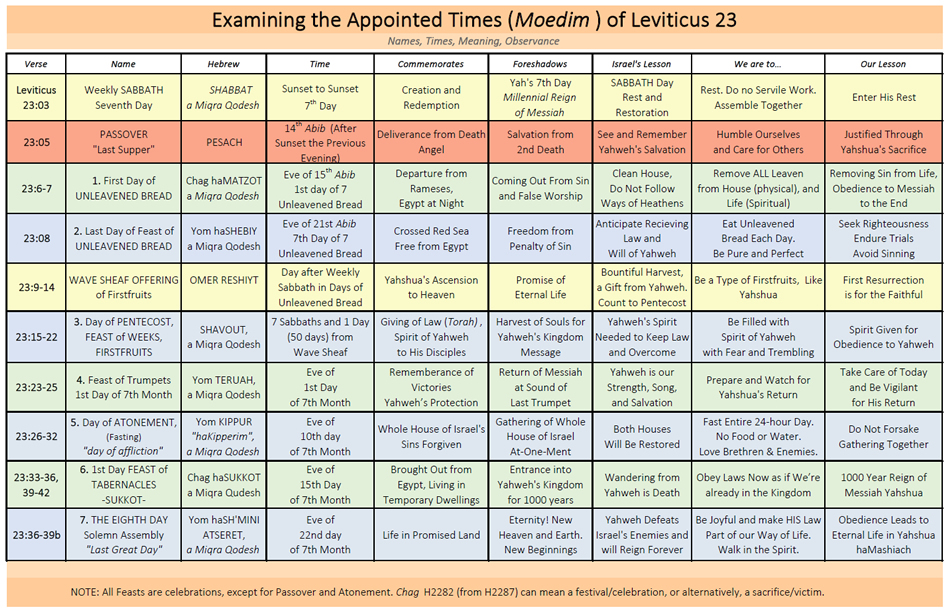
In addition to the weekly seventh-day Sabbath, Yahweh established seven annual High Sabbaths (Holy convocations; in Hebrew, miqrai qodesh) — and two memorial days (moedim, Feast/Appointed Times of Yahweh); which are: the day of Passover and the day of the Wave Sheaf Offering. Yahweh set the seven High Sabbath gatherings according to the three annual harvests of crops in the ancient land of Israel (Ex. 23:14-17). These form the foundation of Yahweh's calendar for Israel, an agrarian society. They are symbolic of Yahweh's harvest of human souls - the spiritual harvest. The annual High Sabbaths, or Holy Days (“Convocations”), are as follows:
• The first and last days of Unleavened Bread, which fall on the 15th and 21st of the Scriptural first month, Abib, Exodus 13:4.
• Pentecost or Feast of Weeks, 50 days (7 Sabbaths, plus 1 day, Lev. 23:15) from the day after the weekly Sabbath within the Feast of Unleavened Bread.
• Feast of Trumpets, first day of the seventh month.
• Day of Atonement, tenth day of the seventh month.
• Feast of Tabernacles, 15th day of the seventh month.
• The Eighth Day, 22nd day of the seventh month, the day after Tabernacles.
The first annual Sabbath follows the memorial day of Passover and occurs on the fifteenth day of Yahweh's first month of the year. It is the first day of the seven days of Unleavened Bread. The second annual Sabbath is the twenty-first day of the first month and is the seventh and final day of the Feast of Unleavened Bread.
Passover, Unleavened Bread and the Wave Sheaf take place in the spring, the beginning of the Biblical year, in March or April of the common (Gregorian) calendar.
Pentecost, meaning fiftieth, is the third annual Sabbath and must be counted to determine when it is observed. Known as the "Feast of Weeks" or "Shavuoth" in Hebrew, Pentecost is a one-day celebration that comes the day after counting seven weekly Sabbaths after the weekly Sabbath within the Feast of Unleavened Bread.
The remaining annual Sabbaths occur in the seventh scriptural month in the fall of the year, September or October. The Day of Trumpets is the fourth (and only) High Sabbath that falls on a new moon, the first day of the 7th Scriptural month. The Day of Atonement follows on the tenth day of the seventh month. It is a holy day of fasting.
The sixth annual Sabbath comes on the fifteenth day of the seventh month and is the first day of the Feast of Tabernacles. The Eighth Day is an annual Sabbath and follows the seven-day Feast of Tabernacles. The Eighth Day is also known as the “Last Great Day.”
Holy Days Pivotal to Important Events
Passover and the Days of Unleavened Bread have been fulfilled twice. The first occurred when Israelites were slaves of the Egyptians. They were "passed over" and spared by the destroying angel because they had obediently smeared blood on the doorposts and lintels of their dwellings. In the New Testament, our Savior was our "Passover" (1 Cor. 5:7) who was put to death on Passover day. He spoke of yet a later fulfillment of Passover, when we will observe it with Him in His Kingdom (Luke 22:15-18).
Pentecost or Feast of Weeks took place when the Covenant was made with Israel and His law was codified. It is a memorial of events at Mount Sinai. In the New Testament, the Spirit of Yahweh was given on Pentecost (Acts 2) to empower Yahweh's people to keep the Law.
It is important that we understand the historical meaning of Yahweh's Feast Days so we comprehend the purpose He is working out on earth and how He is sanctifying His people.
These special days are a shadow of things yet to come; a future prophecy of events yet to unfold. Paul writes for us: Let no man therefore judge you in meat, or in drink, or in respect of a feast day or a new moon or a Sabbath Day, which are a shadow of things to come; but the body of Messiah, Colossians 2:16-17. Do notice that Paul warns us not to let simple man judge in respect to keeping a Feast Day or Sabbath Day for they "are a shadow of things to come." They foreshadow future events meaning they are prophetic.
Anyone who seeks to know prophecy must understand the annual Feast Days thoroughly. The significant acts of man's salvation happened at Feast times.
Understanding the Feasts means we understand the plan of Yahweh and that necessitates that we obey Him and keep His Feasts. He that says, I know Him, and keeps not His commandments, is a liar, and the truth is not in him, 1 John 2:4.
The fall annual Sabbaths are entirely prophetic and await a future fulfillment. These show us a work that Yahweh will yet accomplish for His people. His Sabbaths are the sign He has given between Himself and His people by which we are sanctified.
The Sabbaths were given us so that we might better know Yahweh. They were not given as a meaningless burden to be thrown off and discarded at the Savior's impalement. They have great meaning and purpose behind them. They fit into Yahweh's overall plan anciently, through our day and into the Kingdom.
The Feasts were not done away at the death and resurrection of the Messiah. The Feasts were given to ancient Israel to keep, and they were observed by the Savior and the Apostles.
They are still in effect today and will be kept in the Kingdom, according to Isaiah 66:23, Zechariah 14:16-18, Ezekiel 44-46, and others. If they were commanded for Israel, kept by the Savior and by the New Testament Assembly after His resurrection, and will be kept as statutes in the coming Kingdom, why would they be suspended now? Doesn't it seem as if they are very significant?
It is only by deliberate misinterpretation of Scripture that most of today's ministers teach that these perpetual Sabbaths are done away.
Yahweh's Sabbaths Reveal His Constancy
As previously shown in Ezekiel 20:12, ‘Sabbaths’ means more than the weekly Sabbath, as it is plural:
Moreover, also I gave them My Sabbaths to be a sign between Me and them, that they might know that I am Yahweh that sanctifies them.
These proper days are signs He gives us to help us realize that what He did for His people in the past will be done in a similar way for His people in the future. Then we will know that Yahweh who sanctifies His people - sets them apart for a holy purpose. We will come to a full realization that we are chosen, as was ancient Israel, to take hold of a special promise as they were; to have the chance to become grafted into the covenant by the death of Yahshua the Messiah at Passover (Rom. 11:17; Eph. 2:14).
It must be emphasized, His Sabbath and Feasts are to help us know Who Yahweh is by understanding what He has already done and will yet do. We draw closer to Him by obediently observing the same weekly and annual Sabbaths His beloved Son observed, along with the patriarchs down through the ages. The ones chosen for His Kingdom are those who know Him by doing what He commands.
He promises, Moreover I will establish His kingdom forever, if he is steadfast to observe My commandments and My judgments, as it is this day... keep and seek for all the commandments of Yahweh your Elohim: that you may possess this good land,1 Chronicles 28:7-8.
He that keeps the commandments keeps his own soul; but he that despises His ways shall die, Proverbs 19:16.
Our Creator's Perpetual Handbook
Exodus 34 tells of Yahweh's writing again the Covenant upon two tables of stone, after Moses had broken the originals. Upon returning to gathered Israel at the foot of Sinai, Moses' face glistened because he had communed with Yahweh for some days (Ex. 34:29-35) and now reflected the Heavenly holiness of Yahweh in his flesh.
Verses 18-28 outline the regulations given Moses, including Passover, tithing, and His Holy Days. These festivals are amplified in greater detail in the books of the law, especially the Book of Leviticus. Notice Leviticus 25:1: "And Yahweh spoke to Moses in Mount Sinai saying..."
Take note that it is Yahweh Who instructs us. Moses wrote down His words so they could be handed to us in the Bible, the handbook of our Creator. This handbook reveals the flawless Model, the finished product that Yahweh has made for us to follow: His Son Yahshua Who obediently kept ALL the Feast Days and Sabbaths (John 15:10).
How long are these Feasts to be observed? Leviticus 23 verses 14, 21, 31, and 41 say they are a "statute FOREVER throughout your generations." Out of all the words translated “forever” only two carry the Hebrew meaning of “forever.” In these verses, the Hebrew "owlam" (No. 5769 in Strong's Exhaustive Concordance) means to the vanishing point, to time out of mind. "Alam" (No. 5957), which corresponds to owlam, means the future and past indefinitely. What does this mean? Simply that the Feasts are not optional. They are perpetual, and a definite and obligatory way of life!
These are the words Almighty Yahweh inspired in connection with His Name, the Commandments, and His Feasts. They are truly to be kept forever. In English, forever and perpetual are words understood to mean "time out of time" and are so rendered in Exodus 31:13-18: His Sabbaths "are a SIGN between Me and the children of Israel forever." Please note that the law for Israel is also for any who would join in worship to Yahweh (Ex. 12:49; Num. 15:16; Eccl. 12:13).
In Exodus 31, Yahweh instructed Moses that the Sabbaths are a sign that whosoever keeps them is sanctified by Yahweh; that is, set apart for a holy purpose, the very meaning of "sanctify." Moreover, it is a perpetual (Strong's No. 5769) covenant.
The days themselves remain; only the way they are observed has been changed. The sacrificing of animals is now in abeyance since Yahshua, our perfect sacrifice, has paid the ransom price for those who accept Him.
Notice that Yahshua and His disciples gave us an example of this change at His last Passover, with the symbols of unleavened bread and fruit of the vine becoming the new emblems for this memorial service of His death (Mark 14:22-25). He is the Passover Lamb (1 Cor. 5:7). By Him everyone who believes is justified (Acts 13:39).
His Truth on Earth Nearly Stamped Out
Isaiah 1:14, Deuteronomy 31:29, Matthew 15:8-9 and many other passages show plainly that the New Covenant would be corrupted by Satan the devil through false ministers in the latter days (Jer. 5:31; 14:14). Today we hear another doctrine, another teaching. Amos 8:11 prophesies a most descriptive famine for our day:
Behold, the days come says the Sovereign Yahweh, that I will send a famine in the land, not a famine of bread, nor a thirst for water, but of hearing the words of Yahweh.
Yahweh says in the end time there will be a scarcity of His truth available to the world. Churchianity, in general, erroneously teaches that the Law has been done away, and the Feasts are just for Jews. They have left the Sabbath for Sunday. If hundreds of denominations are in fact teaching the truth, then it was pointless for Yahweh to warn of a scarcity of the truth in our day!
Yet clearly unscriptural, pagan days now replace the days Yahweh gave us. Sunrise services and Easter Sunday worship is nothing more than the idolatrous worship of the Anglo-Saxon Eostre, the Teutonic Estera or the Babylonian Ishtar, a pagan deity, the goddess of fertility. (Easter is found in only one King James verse, Acts 12:4, a mistranslation of the Greek Pascha or Passover.) Christmas’ origin is from the heathen worship of the return of ‘Sol Invictus,’ the unconquerable sun, four days after the winter solstice, astronomically, December 21 + 4 = December 25. Lent is a carryover from the 40 days of weeping for the Babylonian deity Tammuz (Ezek. 8:14).
How can one learn truth when surrounded and inundated by all this error, taken wholesale from paganism and pawned off as Biblical?
The ways of Yahweh are so corrupted and so twisted that the average seeker of truth cannot find his way clear. But through sincere prayer and seeking Yahweh, you can return to the old paths of truth that were given to Yahweh's people, Jude 3. You can find and take hold of that Covenant He makes with His True Worshipers.
His Law for a Thousand Generations
The national debt has been compared to a line of dollar bills, which, if stacked, would reach from the earth to the moon and back.
Yahweh made His own comparison in Deuteronomy 7:9, showing how long His commands are to be honored. Although this was essentially a metaphorical usage and for the sake of argument, let's take it literally. He said His covenant would be with those who keep His commandments for 1,000 generations. There were 42 generations from Abraham to Yahshua, which is a span of some 2,000 years. Since His resurrection, another 2,000 years have passed. No more than 90 generations have passed since Abraham. So looking ahead, Yahweh's Word reveals that His Commandments are still in effect and will continue to be in force for over 900 more generations! Believe Him when He says His law is perpetual. The intent of this booklet is to show the continuity of the Feasts from antiquity to ancient Israel to the time of the Messiah and His Apostles down to our day. We are not scheming to trick anyone into observing days that have passed out of the picture, as some may assume.
In our next chapter we will point out places in the New Testament where Yahshua and the Apostles kept the Feasts that are listed in chronological order in Leviticus 23. In many places in the New Testament we are told to follow Yahshua or to follow those who follow Him (see 1 Cor. 11:1; 1 Pet. 2:21, and 1 John 2:6).
The Feasts were never done away, and are for us today. We are also warned not to follow the ways of the Gentiles and to have nothing to do with their pagan worship (3 John 7; Eph. 4:17). A wealth of sources in any public library will reveal the heathen origins of today's popular holidays. "Learn not the way of the heathen," Yahweh thundered in Jeremiah 10:2. Why won't man listen?
Chapter 3: THE HOLY DAYS THROUGHOUT THE NEW TESTAMENT
Nowhere in the New Testament can we find anyone observing today's popular days. We find no New Year's parties, no mailing of Valentine cards, no Easter bunny, no jack-o'-lanterns, and no Santa Claus. Neither do we find True Believers worshiping on Sunday. What we discover are the very same Feasts that we see being observed in the Old Testament. First, we'll see the weekly Sabbath alive and in force. Leviticus 23:3 clearly admonishes us:
Six days shall work be done: but the seventh day is the Sabbath of rest, an holy convocation; you shall do no work therein; it is the Sabbath of Yahweh in all your dwellings.
Keep in mind Yahweh says these are His set times in Leviticus 23:2. But it is man's introducing his own festivals and his perversion or changing of Yahweh's set times that Yahweh despises. In Isaiah 1:14, He says He hates man's feasts, and even though allegedly in His honor, He will not hear, verse 15.
Note that the weekly Sabbath is called a convocation, a gathering together of Yahweh's people of like faith wherever possible. Those isolated and far away are obligated to cease from mundane labors and rest in Yahweh.
Yahshua's Personal Example for Us
Yahshua the Messiah taught on the Saturday Sabbath, which was His custom. We read in Luke 4:16: And He came to Nazareth, where He had been brought up: and, as His custom was, He went into the synagogue on the Sabbath day and stood up for to read.
Take special note that it was the Savior's manner or custom to join the congregation gathered at the synagogue on the seventh-day Sabbath. This is the example He gave us. We follow Yahweh and His Son when we keep the Sabbath holy and meet with others for worship on the Sabbath. Leviticus 23:3 says the Sabbath day is a "holy convocation," sabbaton miqra qodesh, a righteous gathering with others in worship.
There is no verse anywhere in Scripture where Yahshua told the people that upon His death and resurrection that the Sabbath would be transferred to Sunday, the first day of the week. He Himself never changed the Sabbath from the seventh day to the first day of the week. Nowhere in the entire Bible is such a change made or sanctioned by anyone.
This was done when churchianity adopted the pagan Sun-day, partly in an effort to stamp out anything considered "Jewish." Sunday was established by decree of Constantine in 321 of our common era. He had been a sun worshiper. With the switch, pagans could continue their heathen ways and keep Sunday, but do so in the name of "Christianity."
The word "Sunday" is not found anywhere in the Bible. The "first day of the week" occurs only 8 times in the New Testament. In each of those 8 instances the word "day" was added by translators, and not one of those passages speaks of a worship or a gathering to worship on the first day of the week! By contrast, the word Sabbath is found 60 times in the New Testament.
Luke 6:6 is another instance showing that Yahshua taught on the Sabbath. In Mark 2:27, Yahshua upholds the Sabbath, stating that the Sabbath was made for man (man = anthropos, an individual of the Genus homo, mankind in general). The Sabbath is not only for the Jews or one race of people. It is not "the Jewish Sabbath." It is called Yahweh's Sabbath (Ex.16:23), the same seventh-day Sabbath of which Yahshua is sovereign (Mark 2:27-28). In the Acts of the Apostles we see Paul devoutly keeping the Sabbath.
Notice in Acts 13:42-44: And when the Jews were gone out of the synagogue, the Gentiles besought that these words might be preached to them the next Sabbath. Now when the congregation was broken up, many of the Jews and religious proselytes followed Paul and Barnabas: who speaking to them, persuaded them to continue in the grace of Yahweh.
Had Paul been trying to change worship from Saturday to Sunday, he missed a golden opportunity in not telling them to come back "tomorrow, on the first day of the week." But he did not do that. The Gentiles knew Paul's custom was to attend the synagogue on the seventh-day Sabbath and would return on the next Sabbath! On Saturday. Paul did not tell them to return on Sunday for worship, even though they were Gentiles and not Jews.
Surely you have heard the argument that the reason Paul kept Saturday was so that he might preach in the synagogues when all the Jews would be gathered. Thus, it is reasoned, he could reach more people that way. But in Acts 16:13 we read, And on the Sabbath we went out of the city by a river side, where prayer was wont to be made; and we sat down, and spake unto the women which resorted thither. Note the word "spake," which in the Greek means to preach. This was not in the synagogue, but it was still on the Sabbath.
Other instances of Paul's preaching on the Sabbath are given in the Book of Acts, all of which took place years after Yahshua had ascended into the heavens. Read of them in Acts 13:14, 27; 15:21; 17:2; 18:4.
The reason we draw attention to Paul's keeping the seventh-day Sabbath is that churchianity, as a whole, mistakenly turns to Paul's writings in a futile effort to do away with Yahweh's commandments, especially the Sabbath command.
Many Twist Paul's Writings
Although Paul kept and taught Yahweh's perfect law (Ps. 19:7-8; Acts 24:14; 26:22; 28:23), Peter was inspired by Yahweh to warn that the unlearned and unstable would use Paul's writings in an effort to deceive the elect. He says in 2 Peter 3:15-16, And regard the patience of our Sovereign as salvation; just as also our beloved brother Paul, according to the wisdom given him, wrote to you, as also in all his letters, speaking in them of these things, in which are some things hard to understand, which the untaught and unstable distort, as they do also the rest of the Scriptures, to their own destruction.
Clearly, Peter warns us that some of Paul's writings, though true, are difficult to comprehend properly. It is vital to study Paul’s writings in the context of his Hebraic education and his audience. Inexperienced and undisciplined teachers misrepresent his scholarship for their own doctrines, to their – and their student’s – demise.
When those, who refer to Paul's writings, teach that Paul did away with the Sabbaths, they are elevating Paul above the Savior, Who said He did not come to destroy the law but to fulfill (Matt. 5:17). The word fulfill is the Greek pleroo and means to make replete – well-filled, plentifully supplied. The Emphatic Diaglott, based on the interlineary Greek, translates this verse, "Think not that I have come to subvert, but to establish." The next verse proves that nothing would pass from the Law of Yahweh until all is fulfilled (from the Greek word, genomai, meaning finished).
There is no prophecy in the Old Testament saying that the Sabbath would be changed to another day.
Animal Sacrifices and Feast Not Bound Together
Many confuse the setting aside of animal sacrifices with the termination of the Law and the Feast Days. They say they are all inextricably linked. If one falls, so do the others.
Psalm 40 shows that from the beginning Yahweh did not desire animal sacrifices, but simple obedience is better than sacrifices. Hebrews, chapters 9 and 10, expound on this theme.
Spiritual worship and obedience continue, but animal sacrifices and other sacrificial works and ritual have been set in abeyance for now. There is neither temple nor functioning Levite priests today. But the days of worship — the weekly and annual set times of worship — have not changed. They are perpetual. Psalm 111:7 reads, All His commandments are sure. They stand fast forever and ever.
The sacrifices listed in the Old Testament pointed to the redeeming work of Yahshua the Messiah. The prophet Jeremiah tells us they were added to the law because of Israel's disobedience (Jer. 7:22-24). You can't have disobedience without law (Rom. 4:15).
Animal sacrifices were done on the weekly Sabbath (Num. 28:9-10), but the weekly Sabbath remains binding even without the animal sacrifices, just as observing the annual Sabbath days continues today without animal sacrifices. In fact, sacrifices were done every day (Num. 28:3), for "a continual burnt offering."
Many teachers have used this passage to construct the argument, “If sacrifices were done away, then so must the Feast days.” Their faulty logic does away with all of Yahweh’s Appointed Times! Holy Days are statutes "forever," as we have seen. The observances were, and still are, part of Yahweh's perpetual Law.
Sacrifices have now taken on a spiritual aspect for the sincere believer (Rom. 12:1-2; 1 Pet. 2:5, Heb. 13:15-16). We will soon show that both the disciples and Paul kept these days in the New Testament even after the death and resurrection of the Messiah.
New Moons and the First Month of the Year
Before we get into the details of tracing the Feasts of Yahweh in the New Testament, we must examine the proper time at which we are to observe them, as given in the Bible. Yahweh's calendar has been neglected and all but forgotten today.
Every 29 or 30 days, a thin, scimitar-shaped moon appears in the western sky known as the visible "new moon." This crescent or new moon plays a very important part in determining the Feast Days Yahweh has ordained.
Deuteronomy 16:1 tells us to "observe the month [Hebrew = new moon] of Abib." In plain language it is telling us to visibly watch for the first moon of the new year. That moon comes in the month of the Abib, meaning "green ears" (of barley), in the spring of the year about the time of the vernal equinox. Why?
Yahweh's new year starts when the barley is maturing and in the ear, acceptable for roasting and the wave sheaf offering (Lev. 23:10-11). His year begins when the earth comes to life in the spring with fields of barley (plural: Ex. 9:31, 13:4, and Lev. 23:10), which sets the start for His annual Feasts. The fields should be ready before the new year is announced. Otherwise, a 13th month is declared which automatically keeps the Feasts in their proper seasons.
Some churches merely calculate these times without visibly verifying their appearance and thus can have the wrong dates for observing Yahweh's Feast Days.
Watching for the New Moon in Ancient Days
During and prior to the time of the Messiah there were no telescopes or other aids available as today. So we take Yahweh at His command and search the western sky with the naked eye at the time the moon should be visible. In doing so, we strive to keep the Feasts when ancient Israel, the Messiah, and His disciples did.
In Genesis 1:14, Yahweh set in motion the heavenly bodies to establish the times and seasons. The Hebrew for seasons is "moed," but does not mean the four seasons of the year. Rather, moed means "appointed times" relative to His Feasts, as found in Exodus 34:22-23 and Deuteronomy 14. Yahweh has appointed specific times when He meets with His people.
Anciently, at the arrival of the new moon, a meal was apparently kept in celebration and observance of that special day (1 Sam. 20:5-18; 27-34). The people were alerted to the appearance of the new moon, but it was not a Holy Day (High Sabbath) or Sabbath.
Society's present calendar is actually a solar calendar from Egypt in which the new moons are not intended to begin the month. Our secular calendar completely ignores the new moons, which fall anywhere in the month. During any given year two new moons may fall within a single month in our secular, Roman-Gregorian calendar. Strangely enough, the word "month" derives from "moon." Our culture sets months ("moons") by a calendar that ignores the moon!
New Moon Establishes Feast Days
David shows that the new moon was appointed for the festival seasons in Psalm 104:19. Isaiah points out that the new moon will be kept as the time to set Yahweh's Feasts in the future Millennium, Isaiah 66:23: And it shall come to pass, that from one new moon to another and from one Sabbath to another, shall all flesh come to worship before Me, says Yahweh.
We have, in times past, observed the new moons with a Bible study to memorialize and acknowledge the beginning of a new month of Yahweh's calendar. However, the new moons are not annual Sabbaths, and not a sacred time, except for the new moon of the seventh month, which is known as the Feast of Trumpets. New moons also do not establish the weekly pattern, which was set from creation.
Church-secular holidays such as Halloween, All Saints' Day, Christmas, New Year's Day, and Valentine's Day come during the year irrespective of the moon. These holidays are in the cold, winter season.
But Yahweh's Feasts are seasonal, and at a pleasant time of the year. All of Yahweh's Feast days take place in the cool spring or fall weather. Insect pests are minimal at His Feasts. Contrast this with many churches that hold extra-Biblical "camp-meetings" in the hot summer months of July or August.
The week of Unleavened Bread always begins with a full moon (as does Tabernacles), which means the obedient brethren could always fellowship well into the night, being that electricity was lacking anciently.
We must not neglect the new moons even though they are not Holy Days. Moons are the sign Yahweh gave us that enables us to observe special days at the proper time, and thus to worship Him properly. What could be a better place for such a reminder than the sky?
Yahweh's Assembly in Yahshua publishes a calendar each year showing when the new moons will be visible so that we can determine His Feast days (see our calendar). We as moon-watchers diligently seek the new moon so that the Feast Days will not come upon us unawares. We should be looking ahead to the Feast Days and making plans to observe all seven of them throughout the year.
Remembering His Death at Passover
Three times or seasons in the year the Feasts are to be observed, with a total of seven special Holy Days on which to convocate each year. Leviticus 23 lists and describes all of the annual convocations or gatherings of Yahweh's people. There are seven of them. In Leviticus 23:5 we read, In the fourteenth day of the first month at even is Yahweh's Passover. The Bible calls this "Yahweh’s Passover."
Ancient Israelites were to take a lamb and kill it on the fourteenth as the sun went into the horizon, which began the new day. They took the blood and smeared it on their doorposts and lintels for protection from the destroying angel who came over at midnight. They also were to roast the lamb whole, and eat it that same night.
The Savior gave His disciples new emblems when He instituted the New Covenant on the night before He died. He gave them the cup that held the symbol of His shed blood, and unleavened bread, the symbol of His body. These new symbols replace the animal sacrifices of the Old Covenant. We partake of the bread and the cup to remind us of the Savior's sacrifice of His body and His shed blood in the suffering and death for your sins and mine.
Today, we take the emblems of Yahshua's body and blood in remembrance of His death on Passover, the same night in which He was betrayed (1 Cor. 11:23). We accept His supreme sacrifice for our sins and start away from sin by keeping the seven subsequent days known as Unleavened Bread.
Unleavened Bread and Doctrine to Examine
Leviticus 23:5 tells us that the fourteenth is the Passover. Although Passover is not an annual Sabbath, it immediately precedes the days of Unleavened Bread. Leviticus 23:6 reads, And on the fifteenth day of the same month is the Feast of Unleavened Bread unto Yahweh; seven days you must eat unleavened bread.
By eating token amounts of unleavened bread during each of the seven days, we remind ourselves of the price Yahshua paid for our sins that are past. The ceremonies here portray a spiritual housecleaning, while we examine the doctrines that we believe. Leaven represents doctrine, and for seven days we feed upon the pure and unadulterated doctrinal bread of truth. We are commanded to keep the Feasts in their seasons and to begin training our children to do the same early in their lives, as Proverbs 22:6 reveals, Train up a child in the way he should go; and when he is old he will not depart from it.
This admonition was followed when Yahshua, as a child and along with His family, worshiped Yahweh at Passover and kept the Feast of Unleavened Bread. And when He was twelve years old, they went up to Jerusalem after the custom of the feast. And when they had fulfilled the days, as they returned, the Child Yahshua tarried behind in Jerusalem, Luke 2:42-43.
Yahshua kept Passover during His life and fulfilled prophecies regarding the New Covenant Passover sacrifice. In the midst of His ministry, when He was cut off, He became that perfect sacrifice (Matt. 26:18; Mark 14:14-16; Luke 22:14; John 13:1).
To Accept Yahshua Is to Keep the Feast
Paul explained the redeeming work of Yahshua to Corinthian brethren who were of a pagan background (1 Cor. 5:7-8). Keep in mind that this is written some 25 years after the Savior:
Purge out therefore the old leaven, that you may be a new lump, as you are unleavened. For even Yahshua our Passover is sacrificed for us. Therefore let us keep the feast. not with old leaven, neither with the leaven of malice and wickedness; but with the unleavened bread of sincerity and truth.
Take special note that Paul is writing not to Jews or Israelites. He is writing to the people of Corinth, a Gentile people who were not brought up under the Old Testament teachings of the Bible. Their background and up bringing did not include the worship of Yahweh until Paul came on the scene and taught them the ways of Yahweh.
Why would Paul bring up Passover and the keeping of the Feast to those who were not Jews if these observances were merely Old Testament days done away at Calvary?
Paul relates the great truth that Yahshua has become our Passover. By virtue of the fact that He has been sacrificed for us, Paul says, "Let us keep the Feast!" Nothing whatsoever is said about abolishing or changing the Feast days.
Why did not Paul take the opportunity here to explain a most important point – that the Feasts were done away – if that were the case? But He declared just the opposite. He said that if we accept the Savior's death as our Passover Lamb, then let us keep the Feast of Unleavened Bread. The reverse is also true. If we reject His Passover and Feast we reject His sacrifice for us.
Far from seeking to abolish the laws of Yahweh, Paul upheld them and observed them. He said in the trial for his life before Felix the governor, But this I confess unto you, that after the way which they call heresy, so worship I the Elohim of my fathers, believing all things which are written in the law and in the prophets, Acts 24:14. The law and the prophets are the Old Testament.
In his defense he said, "Men and brethren, though I have committed nothing against the people, or customs of our fathers..." 28:17. The custom of the fathers was to keep the law and Feast days. In verse 23, where Paul explains his doctrine to the chief of the Jews, he tells them he used the law and Old Testament to teach about Yahshua.
Pentecost and the Gift of the Holy Spirit
Leviticus 23:15-16 gives us instructions on the next Feast:
And you shall count unto you from the morrow after the Sabbath, from the day that you brought the sheaf of the wave offering; seven Sabbaths shall be complete: Even unto the morrow after the seventh Sabbath shall you number fifty days; and you shall offer a new meat offering unto Yahweh.
The early disciples in Acts were obediently keeping this special day. It was upon this very day of Pentecost in Acts 2 that the Holy Spirit was sent to earth to remain permanently. Prior to that day the Holy Spirit was given to certain individuals for a specific purpose, and then was taken away. This was nine days after the ascension of Yahshua, and one of the Feasts was about to begin.
Acts 2:1 reveals, And when the day of Pentecost was fully come, they were all with one accord in one place. The disciples were all gathered in Jerusalem, awaiting the promise of the Father, when they were all endued with Power from on High (Acts 2:2-21). This day of Pentecost was the birth or beginning of the New Testament Ekklesia – the Called-out Ones (erroneously known as the "church").
Yahshua had promised He would send the Comforter (Holy Spirit) in John 16:7. He told His disciples not to depart from Jerusalem but to await the promise of the Father, that they would be baptized of the Holy Spirit in a few days (Acts 1:4-5).
Pentecost or Feast of Firstfruits was counted from the Wave Sheaf offering after the weekly Sabbath during the Feast of Unleavened Bread (Lev. 23:15-16).
Yahshua became this Old Testament symbol by presenting Himself as the Wave Sheaf offering in John 20:15-17, thus fulfilling Leviticus 23:10-11. By understanding mankind as wheat and tares in the parables of Matthew 13, we are given a deeper insight into His role as the Wave Sheaf.
The harvest of grain could not begin until the special sheaf was waved before Yahweh. Yahshua thus was the firstfruits unto Yahweh according to Paul in 1 Corinthians 15:23. Because of His acceptance by the Father as the first to be resurrected to life, those who follow will also be raised to immortality just as He was. This will take place at the first resurrection, that first "harvest" of souls which is yet to come.
Breaking Bread on the First Day of the Week
Acts 20:6-7 is referring to Paul's keeping of Yahweh's annual Holy Days. The unlearned try to interpret this as the so-called "memorial supper." Not so! No cup is mentioned. It simply means they broke the typical bread loaves, as was their custom, and ate lunch.
Because most churches do not teach or observe Yahweh's Holy Days, they are ignorant of the Feasts given to Israel. They do not understand that these verses clearly refer to Leviticus 23:15-16. This "first day of the week" merely means the first of the seven weekly Sabbaths in the count to Pentecost ("day" was added by translators; "week" is the Greek Sabbaton, which means "Sabbaths," the weekly Sabbaths).
Furthermore, Bible days start at sunset, so the first day of the week mentioned here is actually our Saturday night. Paul talked until midnight and there were many lamps in the upstairs room, verse 7-8. This was not a Sunday morning meeting. Read our free mini-study, Does Acts 20:7 Teach Sunday Worship?
Take note of Acts 20:16, where Paul is eager to get to Jerusalem by Pentecost. Why? So that he could worship on this Holy Day. That's the reason he came to Jerusalem, according to the very words he told the governor Felix at his trial shortly afterward (Acts 24:11). "I went up to Jerusalem for to worship," He said.
He later tells the Corinthians, a Gentile congregation, that he will come to them and stay over winter. But he will stay at Ephesus until Pentecost (1 Cor. 16:8). If this Feast of Firstfruits had been abolished, why was Paul still observing it and why did he tell these Gentiles that he was staying until then?
The Trumpet Warns
The first three observances – Passover, Unleavened Bread, and Pentecost – come in the spring. They picture the firstfruits harvest, those who are called now to take hold of the Covenant and to eventually rule in the family of Yahweh. The last four Holy Days show Yahweh's plan for the rest of the world at the general harvest of souls. They come in the fall. The fall festivals begin with the Feast of Trumpets. Leviticus 23:24-25 commands this Feast:
Speak unto the children of Israel, saying, In the seventh month, in the first day of the month, shall you have a sabbath, a memorial of blowing of trumpets, a holy convocation. You shall do no servile work therein: but you shall offer an offering made by fire unto Yahweh.
This holy day is on the first day of the month, a new moon. The Jews call this day, Rosh Hashana, the new year. The Bible says it is not the first month but the seventh. The number seven is Yahweh's special number signifying completion and perfection. The seventh month marks the final phase or completion of Yahweh's plan.
Since Pentecost, there have been almost four months of silence. Suddenly this silence is broken by the blowing of trumpets, an announcement of something important about to happen. In Revelation 8:7 through 11:15 the angels sound seven trumpets, each announcing a plague or dramatic occurrence preceding the return of Yahshua the Messiah. Many of these plagues are similar to what the Egyptians faced in Moses' day because they would not obey Yahweh.
The final trumpet announces the victory of Yahweh and His Messiah over the kingdoms of this world (Rev. 11:15). Yahshua will return at the sound of a trumpet (1 Thess. 4:16). And at the trumpet blast Yahweh's angels will gather His people from one end of the earth to the other (Matt. 24:31).
Paul tells us in 1 Corinthians 15:51-52, Behold I show you a mystery; we shall not all sleep, but we shall all be changed, in a moment, in the twinkling of an eye, at the last trump: for the trumpet shall sound, and the dead shall be raised incorruptible, and we shall be changed.
The great works that Yahweh did among mankind on earth were done on His Feast Days. There is no reason to doubt that the return of the Savior will also happen at a specially ordained time. The Feast Days are prophetic.
A significant passage is found in Revelation 1:10, commonly misused to prove Sunday worship. I was in the Spirit on Yahweh's [L-rd's] day, and heard behind me a great voice as of a trumpet. What does "day of Yahweh" [L-rd's day] mean? We see that on this day John heard a trumpet-like voice sounding an alarm. Zephaniah 1:14-16 describes what Revelation 1:10 refers to: a great and terrible day of Yahweh, a day of wrath, trouble, distress, darkness, and desolation. This is not a happy Sunday!
Only Yahweh knows when Yahshua will return (Matt. 24:36). Therefore, Yahshua tells us to watch, verse 42, and be ready. One way we do that is by observing the Feast of Trumpets, a memorial of triumph for the soon coming Messiah!
Solemnity of Atonement
Next comes a most solemn observance (Ex. 30:10), the Day of Atonement detailed in Leviticus 23:27-32:
Also on the tenth day of this seventh month there shall be a day of atonement: it shall be a holy convocation unto you; and you shall afflict your souls, and offer an offering made by fire unto Yahweh. And you shall do no work in that same day: for it is a day of atonement, to make an atonement for you before Yahweh your Elohim. For whatsoever soul it be that shall not be afflicted in that same day, he shall be cut off from among His people. And whatsoever soul it be that does any work in that same day, the same soul will I destroy from among his people. You shall do no manner of work: it shall be a statute forever throughout your generations in all your dwellings. It shall be unto you a sabbath of rest and you shall afflict your souls: in the ninth day of the month at even, from even unto even shall you celebrate your sabbath.
Atonement gets its name from the Hebrew Yom Kippur, which means "day of covering." It signifies the covering of our sins by the blood of the Lamb. We find the Old Testament type in the mercy seat on the Ark of the Covenant. As with "atonement," "mercy seat" derives from the prime Hebrew word, kaphar, which means covering.
Hebrews 9:4 tells us that the tablets of the law were in the Ark, covered by the lid or mercy seat. When the high priest made a sin offering for himself, he sprinkled blood before and on the mercy seat (Lev. 16:6, 14). This symbolized a blood covering for his acts of lawbreaking (sins, 1 John 3:4).
Yahshua's blood is the covering or atonement for our lawbreaking or sins today. Romans 3:25 tells us Yahweh set forth Yahshua to be a propitiation through faith in His blood, to declare righteousness for the remission of sins that are past. Propitiation is from the same Greek word from which mercy seat is derived in the New Testament (hilasterion).
We are commanded to afflict our souls (bodies) for the 24 hours that we observe this day. This means to fast, go without food or drink (Isa. 58:3-5; Est. 4:16).
Only the high priest could enter the Holy Place in the tabernacle, and he could do that only on one day each year, the Day of Atonement (Lev.16:2, 17; Heb. 9:25).
Yahshua became our High Priest (Heb. 4:14, 9:24). He atoned for our past sins, covered them with the offering of His own blood, so that we would not have to pay the penalty of everlasting death.
Note in Acts 27:9 that the writer refers to this solemn fast day 30 years after the death and ascension of the Savior to the heavens. "Now when much time was spent, and when sailing was now dangerous because the fast (Day of Atonement, Strong's Concordance) was now already past, Paul admonished them."
Most Bibles, having marginal notes, refer the fast mentioned here to the Day of Atonement. History records that the sailing season was considered dangerous in this area of the Mediterranean Sea after September 15. This clearly indicates the "fast" referred to here is the Day of Atonement, which falls ten days after the Feast of Trumpets. And it is mentioned by none other than Luke, probably not a Jew but a Gentile.
Some thirty years after Yahshua ascended into the heavens, believers were still observing Yahweh's Holy Days not only in Jerusalem, but Judea, Samaria, and all over the world just as Yahshua had prophesied in Acts 1:8.
In the epistle of Jude, which was written some 35 years after the Messiah was put to death, we read in verses 3-4: Beloved, when I gave all diligence to write unto you of the common salvation, it was needful for me to write unto you and exhort you that you should earnestly contend for the faith which was once delivered unto the saints. "For there are certain men crept in unawares, who were before ordained to this condemnation, wicked men, turning the grace of our Elohim into licentiousness, and denying the only Elohim, and our Savior Yahshua the Messiah.”
He warned the saints then, and by extension warns us now, that there would be unrighteous men creeping into Yahweh's Assembly with their lasciviousness (lawlessness) and turn Yahshua's grace into a lawless doctrine of love, joy, and peace. Through their disobedience they have denied Yahweh and His Son Yahshua.
Let us also contend for that faith once delivered to the saints and through obedience show our love for Yahshua and the faith. Atonement symbolizes the blood covering of all who are washed in the blood of the Lamb as the Assembly awaits His return and the marriage supper of the Lamb.
Yahshua the Messiah Kept Tabernacles
In Leviticus 23:34 we read Yahweh's command for the sixth Feast:
Speak unto the children of Israel, saying, "The fifteenth day of this seventh month shall be the Feast of Tabernacles for seven days unto Yahweh."
The seventh chapter of John shows Yahshua had obediently kept the wonderful Feast of Tabernacles. Note the dynamic wisdom of Yahweh's Word as our Savior taught at this Feast: Now about the midst of the feast Yahshua went up into the Temple and taught. And the Jews marveled, saying, “How knows this man letters, never having learned?” Yahshua answered and said, “My doctrine is not mine, but His that sent Me,” John 7:14-16. See also Luke 4:31-32.
A consistent point made by our Savior was the coming of the Kingdom of Yahweh (Mark 1:14, Matt. 4:23 and Luke 4:43). We also have the teachings of the prophets concerning Yahweh's Kingdom to be established on this earth (Isa. 2:1-4; Jer. 23:6, 33:16; Ezek. 48:30-35; Dan. 7:14, 27, and Rev. 5). All taught the imminent establishment of Yahweh's Kingdom.
After these undeniable proofs, the question we must ask is, were the annual Sabbaths really done away? Furthermore, will they no longer be kept by Yahweh's people after the Kingdom comes?
All Will Be Compelled to Keep Tabernacles
Following the establishment of the Kingdom on earth, Isaiah 66:23 points out in Yahweh's inspired Word:
And it shall come to pass, that from one new moon to another, and from one Sabbath to another, shall ALL flesh come to worship before Me, saith Yahweh.
The whole world will be keeping the weekly and annual Sabbaths of Yahweh from month to month, Sabbath to Sabbath, when Yahshua rules. This will take place after the great destruction and war prophesied for the end of the age. Yahweh is calling out a people to rule with the Messiah and to teach others His laws.
Zechariah clearly shows that Yahweh will discipline those who don't think the Holy Days and Sabbaths are important in the times ahead of us. Notice his warning in Zechariah 14:16-19:
And it shall come to pass, that every one that is left of all the nations which came against Jerusalem shall even go up from year to year to worship the King, Yahweh of hosts, and keep the Feast of Tabernacles.
Take note that this takes place after the great battle around Jerusalem at the end of the age, all of which is future. Let's continue with Zechariah: And it shall be, that whoso will not come up of all the families of the earth unto Jerusalem to worship the King, Yahweh of hosts, even upon them shall be no rain. And if the family of Egypt go not up, and come not, neither shall it be upon them; there shall be the plague wherewith Yahweh will smite the heathen that come not up to keep the Feast of Tabernacles. This shall be the plague wherewith Yahweh will smite the heathen that come not up to keep the Feast of Tabernacles. This shall be the punishment of Egypt, and the punishment of all nations that come not up to keep the Feast of Tabernacles.
As we have just seen, Yahweh's Feasts will eventually be kept by all nations, including the heathen. Everyone will be keeping His special days ordained for our own good. Just as ancient Israel was called out of a heathen Egypt to observe His Feasts (Ex. 3:18, 5:1, 7:16; Hos. 11:1), Yahweh today is calling out of the world a people for His Name, to observe His Feasts and to spend this special time in a deeper study of His Word.
His days prepare us for the millennial rule of sacred Law and Order. Living apart from the world for a week in joyful peace and plenty becomes meaningful spiritually as well as physically.
Chapters 43-46 of Ezekiel indicate what will take place during the Millennium. Ezekiel 45:17-25 shows that not only will everyone keep the new moons and Feasts, but also those who have not yet surrendered to Yahweh will find that they must worship Yahweh just as did ancient Israel – with animal and meal sacrifices and offerings!
They will learn of Yahweh by performing the various offerings and doing exactly as ancient Israel did. Thus, through experience everyone will learn that all worship centers on Yahweh, and Yahshua is the only way we can approach Yahweh. He is the "door" to pure worship (John 10:7). Yahshua died once for the sins of the world and will not die again.
We are given the opportunity now to learn the purpose behind the various sacrifices and the deeper meaning of the worship Yahweh has ordained. Although we do not sacrifice animals and grain, ours is now a spiritual sacrifice (Rom. 12:1; 1 Pet. 2:5).
The Eighth Day
In Leviticus 23:36 we read of the last Feast: Seven days you shall offer an offering made by fire unto Yahweh: on the Eighth Day shall be an holy convocation unto you; and you shall offer an offering made by fire unto Yahweh: it is a solemn assembly; and thou shall do no servile work therein.
Yahweh's people are being called to be in His Kingdom, Revelation 1:6, and to reign on earth, Revelation 5:10. Those in the first resurrection won't be affected by the second death (Rev. 20:6).
If you are worthy of that first resurrection, you will become a priest in the Kingdom under Yahshua the Messiah, our High Priest. You will be expected to teach others Yahweh's law. This includes the observance of both the weekly and annual Sabbaths, for as already shown, Zechariah says all those remaining after the end-time battle around Jerusalem shall come to Jerusalem to worship (Zech. 14:16-18).
Assume you made the first resurrection and are in the Kingdom. Yahshua says to you, "Go and tell that group of people in (a certain area) that they must come and keep the Feast of Tabernacles." How would you know when it started? Would you know what to do during the Feast? Would you know how long the Feast lasts?
Suppose these people refuse to come. Yahshua tells you that if they don't come, you are to keep the rain from them. If they still refuse to come, you are to bring a plague upon them.
Provocative Question from the Future
What response could you give if they said to you, "What gives you the right to tell me to keep the Feast of Tabernacles when you have not kept it a day in your life? How can you keep the rain from us when you yourself do not even know how long the Feast is to be kept? How can you bring a plague upon us when you don't know about the Feast, don't know what to do, and have not kept it yourself?"
How would you answer these questions? Could you state that you observed Yahweh's Feasts when it seemed the entire world ignored His Word? Could you say you kept them as best you could and met with His people in convocation as we are commanded?
Even in our world, a judge does not hold court unless he has a good understanding of the laws of the land. He must first be trained or serve as a practicing attorney who passed the bar examinations. To be a priest and a judge in Yahweh's Kingdom we are expected to render righteous judgment. We learn His ways now!
We are to study His Word so that we comprehend the deeper meaning of the sacrifices and study the rich meaning of these special days that Yahweh has given us for our own good.
You may be saying, "Oh, when the time comes, Yahweh will teach me all I need to know to rule in His kingdom."
There are many places in Scripture warning us to make ourselves ready now while we have the opportunity. Take note of Revelation 19:7, which says, Let us be glad and rejoice and give honor to Him; for the marriage of the Lamb is come and His wife has made herself ready. We are not to wait and expect the Savior to tell us everything later.
Yahshua kept this Great Day of the Feast (the Eighth Day) with the assembled Jews, according to John 7:37 (where the phrase “the Last Great Day,” originates), In the last day, that great day of the Feast, Yahshua stood and cried, saying, “If any man thirst, let him come unto Me, and drink.”
We believe that the Eighth Day refers to the time following the white throne judgment of Revelation 20. But Yahshua was referring to much more than that. He went on to say that those who believe on Him as the Scripture has said, out of His belly (innermost being) shall flow rivers of living waters. What did He mean?
Zechariah 14:8 indicates that waters refer to Yahweh's Spirit, everlasting life, as in Isaiah 32:1-3:
Behold, a king shall reign in righteousness, and princes shall rule in justice. And a man shall be as a hiding place from the wind, and a covert from the tempest, as streams of water in a dry place, as the shade of a great rock in a weary land.
Isaiah 55:1 gives us the same promise:
Ho! Every one who thirsts, come to the waters. And he that has no money; come, buy, eat. Yes, come buy wine and milk without money and without price.
The Eighth Day pictures the earth finally at peace, with the Spirit of Yahweh permeating not only humans but all creatures on this planet will also benefit from the Edenic paradise. Everyone in eternity will continue to submit to Yahweh's laws, and life will be serene and joyfully productive.
Although the religious leaders at the Feasts did not believe Yahshua, He spoke of the "living water" to the woman at the well in John 4:14. But to the Pharisees He quoted Scripture that they should have known. Compare Isaiah 12:3 with 55:1; Ezekiel 47:1; Joel 3:18; and Zechariah 13:1; 14:8.
Now is the Time to Commit to Almighty Yahweh
The time is coming when the Spirit of Yahweh will cover the earth as the waters cover the sea. His way of life will be enjoyed by the entire earth and the sin we find in this world will be no more.
Right now Yahweh is calling a people for His Name. He will build again the tabernacle of David which has fallen and will build again the ruins of it, that the residue of men may seek after Yahweh and all the Gentiles upon whom My name is called, Acts 15:16-17. Why is all this important to you? Right now Yahshua is building His assembly. A special people are now being called to be kings and priests in His Kingdom. Note Revelation 1:6:
And He made us a kingdom of priests to His El and Father; to Him be the glory and dominion forever and ever. Amen.
We must not coast along, satisfying purely our own desires. The Bible says we must make ourselves ready NOW! Our purpose in life is to learn of His ways. This is clear in Psalm 45:13-15; 1 Thessalonians 3:13; 5:23; 2 Peter 3:14, and Colossians 1:22.
Yahshua told a sobering parable in Matthew 25 about five wise virgins who had oil in their lamps and were ready for the Bridegroom when He came. Five other virgins were foolish, and did not prepare for Him. For them, getting themselves ready wasn't important. For them, obedience didn't mean anything at the time. But when they heard that the Bridegroom was coming, they begged oil of the five wise virgins, but were told to go and buy their own. While they were gone, He came and they were left out. The point? "Watch therefore, for you know neither the day nor the hour wherein the Son of man comes," verse 13.
Will it soon be too late for your own obedience? We hope not. We pray you'll want to start serving Him today!
Chapter 4: HOW WE SHOULD KEEP THE FEASTS TODAY
Very few in our society keep the weekly Sabbath, and even fewer observe the annual Sabbaths. Why, then, do we teach that both the weekly and annual Sabbaths must be kept by the people of Yahweh?
As already stated, Yahweh said His Feast Days are to be kept forever. They were given to ancient Israel, but Scripture proves that special days were kept even back in Genesis 4:3-7. Abel brought the Passover offering to Yahweh, but Cain brought the Tabernacles offering.
Abel came through the blood of the lamb. Cain came with the work of his hands. The Hebrew "process of time it came to pass" means "at the end of days," and carries the sense of time suddenly coming to a halt as something very important was about to occur. It was a special time of introspection.
The Companion Bible notes that the time and place were evidently appointed. Thus, the Feasts were observed after Adam was driven from the Garden as the way in which man could return to Yahweh.
Other scholars have traced the sojourn of Abraham as he left Ur of the Chaldees and have demonstrated that he left at Passover, the same time as ancient Israel left Egypt. His journey from Haran to Bethel/Hai and then to Egypt and back parallels the keeping of the annual Holy Days!
Passover
Passover is to be observed on the fourteenth of Abib, the month in which barley appears. This is usually in our March or April, according to Yahweh's calendar. “Abib” is often translated as “green (early) ears” of grain. In Exodus 9:31-32 we note the grain is barley, but it was not immature. When barley is able to be roasted (Lev. 2:14), we can identify the new year (Lev. 23:10-11). See Biblical Timekeeping on the back of our calendars for more information.
Jews have a calculated calendar, but it includes a number of postponements which are not found in the Bible.
The Jews also keep the fifteenth day of the first month as Passover, while the Bible always says the fourteenth is the Passover (Lev. 23:5), and the fifteenth is the Feast of Unleavened Bread (v. 6). Remember, the Biblical day changes when the sun sinks into the horizon. One day ends and another begins.
Sunset is usually about 7:00 p.m. at Passover, and services usually start around this time. The participants should all be adult, spiritually prepared, and baptized into Yahshua's Name. The basic qualifications are found in Exodus 12:43-49. The "circumcision made without hands" is through baptism (Col. 2:11-12).
After a short explanatory sermon on Passover, John 13:1-17 should be read and then followed by a symbolic foot-washing of another's feet to show humility in service to our brethren. A basin of water and a towel are all that is required. It is usually more acceptable and proper in a group to pair up man to man, and woman to woman.
Unleavened bread or matzos should be readied in advance, by breaking and placing them on a plate and covering with a white cloth. The Bible symbol of blood has been shown to be the juice of the grape. Note that Yahshua called the contents of the cup, "fruit of the vine." Wine is a fermented by-product. The fresh grape juice should be poured in individual cups and covered beforehand.
After the foot-washing service, the broken pieces of unleavened bread are blessed through prayer, and passed to those participating. A further reading of Mark 14:22-25; Matthew 26:26-29; or Luke 22:19-20 helps set the tone of this solemn service. Then the fruit of the vine is blessed in prayer and passed to the participants.
A reading of 1 Corinthians 11:17-34 also is very helpful. The Corinthians had turned the Passover memorial supper into a heathen feast. They were eating and drinking to excess as if it were a banquet of revelry and had failed to recognize the spiritual significance of this solemn occasion.
This is a night to be much observed. It is not a night for visiting or talking. It is to remember the Savior's death and should be a very solemn occasion much like a funeral.
Passover is the first of the annual observances. We accept the Savior's sacrifice and acknowledge the tremendous price He paid for our redemption. But this is just the beginning. Many churches celebrate Passover and stop. Others have perverted it by taking the memorial supper for breakfast. Or always on a Sunday. And every week, once a month, or each quarter. But Passover is a memorial of His death, something we remember once each year, on the date He died. That is the command we are given.
Feast of Unleavened Bread
After partaking of the Passover on the 14th of Abib, we continue with the Feast of Unleavened Bread at sunset on the 15th. Remember that a Scriptural day begins at sunset the evening before. We have the example of Paul who had gained converts from the heathen population at Corinth. They obviously had not kept the Passover or the Feast of Unleavened Bread which Yahweh revealed to His people, Israel. Paul wrote to the Corinthian brethren: "For even the Messiah our Passover is sacrificed for us: Therefore let us keep the feast..." (1 Cor. 5:7-8).
Yahweh's annual Sabbaths are an everlasting sign between Him and His people, showing us a deeper understanding of His plan for redeeming mankind. Yahweh teaches us spiritual lessons through physical activity. We gain a clearer picture by the types set for us in the Old Testament.
While Passover is a solemn occasion, the Feast is a joyous time. Yahweh's Feasts are to be happy occasions. This Feast commemorates Israel's leaving their individual houses and gathering at Rameses. Together they marched out of Egypt at night, on Abib 15 (Deut. 16:1), the first day of Unleavened Bread, a High Sabbath.
For the duration of these seven Feast days we rid our houses of physical leaven as a reminder to rid our spiritual lives of false doctrine that leads to error, hypocrisy, and wickedness. We cling only to the teachings that are scriptural. Symbolically, we have put out the old leaven (doctrine) and taken in only the pure truth. It is like a spiritual housecleaning where we examine the doctrines we believe, to be certain they are in harmony with the Bible. Leaven represents doctrine that can be good or evil.
Notice that leaven is present in the loaves used during the Feast of Pentecost (Lev. 23:17). Leaven is not necessarily sin, wickedness and corruption, although it can be. But small amounts permeate the whole loaf for good, Matthew 13:33; or evil; 1 Corinthians 5:7-8.
Prior to the Feast of Unleavened Bread all leavened products are to be removed from our homes. They include bread, cookies, soda crackers, and yeast. Not only must we remove leavening, but we are also commanded to eat at least a token amount of unleavened bread on each of the seven days of the Feast of Unleavened Bread. On the first (Abib 15) and last (Abib 21) no work is to be done other than what is necessary for the Feast, as both days are High Sabbaths. We must do as much preparation as possible to avoid profaning the High Days.
The first day is a memorial of leaving Egypt, and the last day of Unleavened Bread is a memorial of Israel's passing through the Red Sea completely free from Egypt.
Pentecost, Feast of Weeks or Firstfruits
Pentecost or Feast of Weeks is always on a Sunday, as it occurs 50 days from the day after the weekly Sabbath that falls during the days of unleavened bread (Lev. 23:15-16). (The day to count from in verse 15 is Shabbat, the weekly Sabbath – not Shabbathown, which, in context, could imply an annual Sabbath.) The count begins with the wavesheaf offering on the morrow after the weekly Sabbath. The Jewish calendar counts the days from the first annual Sabbath (Abib 15) during Unleavened Bread and therefore always ends up with Sivan 6. But the Bible says we are to count the 50 days or seven weeks (hence "Feast of Weeks") from the day the wavesheaf was offered. What would be the point in counting off the days if we always ended up on Sivan 6, as do the Jews?
Pentecost is a joyful, happy time for the believer. It signifies the giving of the law in the Old Testament, and the coming of the Holy Spirit to this earth to empower Yahweh's people to keep the law in the New Testament. This Feast signifies entering into the New Covenant by the power of the Holy Spirit. It is a time to rejoice, to join in convocation with Yahweh's people and be taught the Word. No labor is done. Pentecost begins as the weekly Sabbath ends at sunset and lasts all day Sunday until sunset that evening.
This Feast affords a wonderful time to study again the ratifying of the Covenant in the Old Testament and the giving of the Holy Spirit in the New, which enables us to keep the Law Covenant. This is the third of seven annual Sabbaths.
Feast of Trumpets
Trumpets is a time we expectantly look for the return of the Savior. Rejoicing may not seem proper because when the seals are removed from the rolls of Revelation chapter 6, a time of trouble, wars, and tribulation will begin. But these heralds the time Yahshua will receive power to begin His work, which will ultimately bring an age of peace and blessing as the Kingdom of Yahweh is established on this earth.
The day of Trumpets is the first day of the seventh Bible month and comes in the fall, usually in September. It is a Sabbath in which no work is to be done except for the preparing of the food for the day. It is a joyful convocation of Yahweh's people. The lessons of Jacob's trouble should be reviewed, as Yahshua will begin His work of redeeming all Israel and bringing them back to their land.
Atonement
This is often looked upon as the holiest of all days in Yahweh's calendar. It falls on the tenth day of the seventh month when no work of any kind is to be done. Yahweh commands His people to fast on this day. Examples of fasting reveal it means going without food or water from sunset as the day begins until sunset at the day's end. Please read Leviticus 23:32; Psalm 35:13; 69:10; and, Jonah 3:5-10.
Fasting on this day is for Yahweh's people who have prepared themselves spiritually to observe this day. Young children and the elderly often do very well in handling this day if prepared for it, but even a partial fast for them is indeed "afflicting their soul." Atonement brings to mind the fleeting nature of life and our dependence upon food and water. In Yahshua, we find immortality, immortality from Yahweh.
Atonement is known in Hebrew as "Yom Kippur," a day of covering. It meant the sins of the people were covered until the next year. The return of the High Priest from the Holy of Holies was met with joy and happiness (Lev. 16:17). In the same way, we wait with joy for the return of our High Priest, Yahshua Messiah, when He redeems His own and reestablishes the Law and order once given to mankind by His Father.
Feast of Tabernacles
The Feast of Tabernacles lasts for seven days. The Feast begins on the fifteenth day of the seventh month, which is a holy day observed as a Sabbath of no work.
This is the true Thanksgiving as we thank Yahweh for the growing season and harvest. Tabernacles also points to a spiritual harvest of souls.
This is a joyful gathering, a Holy Convocation of Yahweh's people. It is one of the three "Pilgrim Feasts" (in addition to Unleavened Bread and Pentecost). We leave our homes and “tabernacle” with Yahweh's people, staying in temporary dwellings to observe this time.
Yahweh will make His people dwell in tents as in the Feast of Tabernacles (Hos. 12:9). Thus, we are reminded physically that we are but sojourners here on earth. Tabernacles is our witness to the world that we believe Yahweh's promise of the coming Kingdom. Yahweh uses physical lessons to teach us a spiritual truth.
The Eighth Day (also known as the "Last Great Day")
Following the Feast of Tabernacles, the Eighth Day is one of the seven annual Holy Convocations or Sacred Assemblies (a "miqra #4744 qodesh" #6944 - a "sacred rehearsal" of prophesied Messianic events, Lev. 23:36; Neh. 8:18). It is referenced in John 7:37 as, “the last day, that great day of the feast.” In as much as the seven days of the week point to seven-thousand prophetic years, the Eighth Day points to the time AFTER the reign of Messiah in the seventh Millennium, AFTER the White Throne Judgment of Revelation 20:11 and AFTER “the second death” of those not found in the Book of Life and cast into the lake of fire (Rev. 21:1). The Eighth Day is a “time-out-of-time” – the time of a New Heaven and a New Earth (Rev. 20:14).
This “rehearsal” of the Eighth Day is a special Feast Day and a joyful Convocation for all of Yahweh's people. It is a “day” that is prophesied, in which “all shall know Yahweh” (Jer. 31:34; Heb. 8:12). He has kept His promises and fulfilled the Covenant He made with Abraham. Now His people can enjoy Life Ever After.
The Feast Days allow us to study and unlock Yahweh's prophecies. Those who obey His Word will understand and know the message of Salvation and Redemption.
Points to Ponder...
Yahweh’s Word cries out to us, “Honor My Sabbaths! Walk in My ways, as did My Messiah!” These seven, annual High Sabbaths – accompanied by Passover and the Wavesheaf of Firstfruits – were given as part of the Covenant and to be kept forever.
Peter tells us we are to walk in Yahshua's footsteps (1 Pet.2:21). The Feasts were kept by Yahshua’s disciples long after He ascended to heaven. Paul kept them (more than 25 years after Messiah's death!) and tells us to follow him as he follows the Messiah (1 Cor. 11:1).
After reminding believers of the salvation from the consequences of sin that Yahshua’s sacrifice offers us, Paul rebukes outsiders who mock the Feasts of Yahweh, Colossians 2:16-17: Therefore, let no man [specifically, non-believers] judge you in meat or drink or in respect of a Sacred Assembly, or of the new moon, or of the Sabbaths, which are a shadow [a “picture”, a prophecy] of things to come; but the body [the Assembly] of Messiah [is to judge]. The Feasts are prophetic – Holy Days, new moons (the Day of Trumpets) and Sabbaths foreshadow events yet to come!
The Feasts will be strictly kept again when Yahshua returns and sets up the Kingdom (Isa. 66:23; Rev. 12:5). To what purpose would it serve to set them aside now? Obviously, it would only serve Satan’s purpose, to tempt believers to transgress the Law of Yahweh (1 John 2:4) – and lead them to destruction! (Matt. 7:13).
Chapter 5: WHY ISRAEL WAS TAKEN CAPTIVE: A LESSON FOR US
There is yet another consideration that is a great lesson for us. The way of life we are to follow is much like that shown ancient Israel. Because of Israel's refusal to keep the Sabbatical and Jubilee years, they were taken captive to Babylon until the land had the neglected rest. Notice 2 Chronicles 36:20-21:
And them that had escaped from the sword carried he away to Babylon; where they were servants to him and his sons until the reign of the kingdom of Persia: To fulfill the word of Yahweh by the mouth of Jeremiah, until the land had enjoyed her Sabbaths: for as long as she lay desolate she kept Sabbath, to fulfill threescore and ten years.
Yahweh is explicit and unequivocal in expecting His law to be followed. When He shows us an important truth, He counts on us to keep His Word and obey even what we might think is the smallest command. The seventy years in Babylon were a punishment for His people for not keeping the Sabbatical/Jubilee years. Nehemiah 10:31 shows they learned a lesson, and did not forget the Sabbath, Holy Days or seventh-year Sabbatical when they returned from captivity.
Yahshua calls us by revealing deeper truths. If we follow His leading, we are given more truth. If we reject His truth, then there is no reason for Him to reveal more, as we have already turned our back on His calling us to obedience.
A deeper study of the Sabbatical/Jubilee cycle, which recently was on Atonement 2015/2016, may well offer a clue to the return of the Messiah. But that is another subject.
Worthy to Escape What Is Coming
Bible prophecy describes a soon-coming period of tribulation so bad that nothing like it has ever occurred since the beginning of the world, nor will ever happen again. We can read about the calamities that will be prevalent when Yahshua returns in such places as Matthew 24, Mark 13, and Luke 21. There will be wars, widespread famine, disease epidemics, earthquakes, and widespread killings.
Events will be so terrible that people's hearts will fail them because of their fears, Luke 21:26. The masses won't know where to turn for safety. Joel 2:2 calls it a day of darkness and gloominess.
This is just the opposite of what we hear from today's pulpits: "Oh, what a wonderful, glorious time it will be when the Messiah returns."
The Word of Yahweh tells us that Yahshua will return with a sword, 1 Corinthians 15:24-27, to subdue the belligerent nations of this world before He takes over with His righteous government.
In Luke 21, Yahshua reviews these terrible times. In verse 36, He encourages us to watch and pray:
Watch you therefore, and pray always that you may be accounted worthy to escape all these things that shall come to pass, and to stand before the Son of man.
To be accounted worthy means that there is something we can do that will assure us an escape from the severe tribulation that is coming upon the earth. We are offered protection from the coming catastrophe, and a reward, if our works measure up (Rev. 22:12).
Ancient Israel was given the Holy Days (Ez. 20:12), which served as a sign to set them apart as special and protected. When they observed them, they prospered and defeated all their enemies. When they disobeyed and "polluted My Sabbaths" (v. 16), Yahweh withdrew His protective hand from them (v. 22). Unprotected because of their disobedience, Israel would suffer tribulation and defeat from her enemies.
Paul tells us in 1 Corinthians 10:11-12 that Israel's lessons are for us today. When we obey and keep the commandments and Holy Days, we are blessed and protected. When we disobey, all sorts of afflictions beset us. Try it in your own life and see whether Yahweh's Word holds fast today!
Science boasts that knowledge is doubling every year (or even less now). The world is interested in the knowledge of scientific technology, but in general, neglects and spurns Bible knowledge, which is also increasing. Prophecies are being fulfilled. Yahweh inspired Hosea to write in Hosea 4:6, My people are destroyed for lack of knowledge: because you have rejected knowledge, I will reject you, that you shall be no priest to Me: seeing you have forgotten the law of your Elohim, I will forget your children. This is certainly descriptive of our day. It is not that true Bible knowledge isn't available, but the problem is a lack of sincere desire to obey what we learn!
"Sacrificing" Now for the Kingdom
By now there should be no question in your mind, not even the slightest doubt, that Yahweh's Sabbath and Holy Days are in effect today. Anyone who desires a part in the Kingdom must keep them today. Doing so can indeed mean a sacrifice on our part. We have to set aside our vacations for His Feast Days so that we can assemble in convocation three times a year with other scattered brethren. Being obedient means leaving the comforts of home and staying in temporary dwellings as Israel did. Considering what it means to be obedient to your Creator, this is only a minor inconvenience.
While obedience may not be a great sacrifice for us, it is evidently too much for the vast majority who do not undertake the effort now.
Yahshua said we must be "accounted worthy" to stand before the throne and the Lamb. You can prove your sincerity and desire to be one of His Chosen by determining right now to keep the weekly and annual Sabbaths.
If Yahshua finds us worthy, we will be given a position to teach His laws and rule with Him in the Kingdom, which is the promise of Revelation 20:6. If you are going to teach others how to keep the Feasts, first you must know all about them! You must be intimately familiar with them yourself.
A swimming instructor must know how to swim. A pilot trainer had better know how to fly himself. A judge must be familiar with the law before he renders judgment; and he must be a law-abiding judge himself or be disqualified. How can we expect Yahweh to place an unqualified person in authority if he has not shown his resolve and dedication to be governed by the laws of the Kingdom?
Only a Precious Few Find the Narrow Way
Following Yahshua will mean a road different from what the world in general travels. Obedience to Yahweh means going against the mainstream, leaving behind some relatives and friends who cannot understand the truth of the Bible at this time.
Our Savior explains that not many find that true way:
Enter ye in by the narrow gate: for wide is the gate, and broad is the way, that leads to destruction, and many are they that enter in thereby. For narrow is the gate and straitened the way that leads unto life and few are they that find it, Matthew 7:13-14.
We shouldn't expect that many will want to obey the Word, as we have proved it. Most people have earthly goals, be they money, friends, or prestige. The whole orientation of their lives is carnal and not spiritual. In that state they are at natural odds with the truth. Because the carnal mind is enmity against Yahweh: for it is not subject to the law of Yahweh, neither indeed can be, Romans 8:7.
Full obedience to Yahweh means that we will be given protection and guidance in all we do. Furthermore, He promises that our personal property will be guarded while we attend His Feasts. Note His promise:
For I will cast out nations before you, and enlarge your borders: neither shall any man desire your land, when you go up to appear before Yahweh your Elohim three times in the year, Exodus 34:24 TS.
The same Sovereign One, Who guarded Israel, will honor His pledge to those who take hold of His Covenant.
Financing the Feasts: How You Can Go
"But I just never seem to have the money to go to the Feasts," you may be saying. In His wisdom, Yahweh has provided for this situation.
Deuteronomy 14:22-26 applies to setting aside finances for attending the Feast Days.
Note verses 23-24 TS: And you shall eat before Yahweh your Elohim, in the place which He shall choose, to cause His name to dwell there, the tithe of your grain, of your new wine, and of your oil, and the firstlings of your herds and of your flocks; that you may learn to fear Yahweh your Elohim always. And if the way is too long for you, so that you are not able to carry it, or if the place is too far from you which Yahweh your Elohim shall choose to set His name there, when Yahweh your Elohim shall bless you; Then shall you turn it into money, and bind up the money in your hand, and shall go to the place which Yahweh your Elohim shall choose.
Note verse 26 commands us to "eat there before Yahweh your Elohim, and you shall rejoice, you and your household.” This tithe was/is to be used to enjoy Yahweh's Feasts and was anciently to be shared with the Levite. (When the Levitical priesthood is established once again in the coming Kingdom, this will be done again. We read of this in Ezekiel chapters 40-48 by the physical people brought through the Great Tribulation. Now we keep the Feasts in the Melchizedek order, in Yahshua our High Priest. See our in-depth booklet called Orthodox Believers for more information).
This tithe is a special or "second" tithe that we are to set aside to assure our attendance at the Feasts where Yahweh has placed His Name. Many will set aside a "vacation fund" to take a trip somewhere. What could be more important than enjoying eight days with those who will be with us in the Kingdom, at the Feast of Tabernacles in “Main Street Millennium”? This is not the first tithe, which is to establish and glorify His worship. This second tithe is the responsibility of the individual believer who has the privilege and now the means for attending Yahweh's Feasts. When Yahweh's people follow His commandments, no excuse can be made for not sharing in the joy of attending the Feasts. This Festival tithe is set aside specifically to enjoy the Feasts. It is a discipline we gladly assume. In addition, we are to make preparations beforehand – long before the Feasts. If we need new tires for the car for the trip, we make sure we have those. Any tune-ups or maintenance work is taken care of prior to the trip. We must do what we can to ensure safe and reliable transportation.
If we require airline tickets, we make reservations weeks and even months in advance to be assured of the best flight. Usually, we can economize by buying the ticket ahead of time.
Because keeping the Feasts means staying in a temporary dwelling, we acquire necessities throughout the year such as camping gear, warm clothing, and rain gear. Except for Pentecost, the Feasts occur when the weather is a bit cooler. Just as with ancient Israel, today's sincere believer in Yahweh finds that his entire life revolves around the set times of Yahweh's Feasts.
A Fellowship that Spans All Time
The blessings and deeper faith we gain from keeping the Feasts extends beyond today. In the Kingdom we can share our experiences with Moses and the Israelites; with Paul and the other Apostles; with Yahshua Himself, and with those we will have the responsibility to teach.
Time thus spent is truly a fellowship for all time. What other activity carries such significant fellowship with Yahweh and His people throughout all ages? The question on a sincere believer's mind, a person who desires above all else to be in that first resurrection, is not "Shall I go to the Feast?" The question is "Where will the Feast be held?" Yahweh's command is there: "Three times in a year you SHALL appear before Me!"
John, the beloved disciple, wrote the following so that we might also benefit from his deeper knowledge of the Savior:
If we claim to have fellowship with Him yet walk in darkness, we lie and do not put the truth into practice. But if we walk in the light, as He is in the light, we have fellowship with one another, and the blood of Yahshua His Son purifies us from every sin, 1 John 1:6-7 NIV.
No wonder the Feasts are considered a taste of the coming Kingdom! Almighty Yahweh has now opened up a whole new understanding of His Word to you through His Holy Days. What will you do with this Knowledge? Act on it, or bury it as did the man with the one talent in the parable of Matthew 25?
In another parable in Luke 14, Yahshua the Messiah told of a ruler who made a large feast and invited many to come. But they all made excuses. One said he had a piece of land he had to look after. Another had to go try out his new oxen. A new wife was the reason another couldn't make it.
Angered at all of this, the master told his servant to go out and invite anyone along the roadway who would come. He vowed that none who had turned Him down would ever eat His supper.
The lesson is unmistakable. Yahshua is calling you now to have a part in the marriage feast of the Lamb, to be His bride and join to Him when He returns to rule this earth. By accepting His invitation now, to be obedient to all of His commands, you will feast with Him in the Kingdom forever. Ignore or reject the call and you are actually saying no to your Heavenly Father and His promises!
Chapter 6: BEGINNING OF MONTHS
Scriptural Year Begins?
When does a Scriptural year begin? Yahweh and Moses apparently were viewing the thin, scimitar-shaped crescent of the new moon and Yahweh said unto him, This month [moon, chodesh] shall be unto you the beginning of months: it shall be the first month of the year to you, Exodus 12:1-2.
The Hebrew word #2320 (chodesh) can mean either new moon or month. Chodesh is from the root #2318 (chadash), meaning to be new; cause to rebuild, renew, repair. It is the rebuilding phase of the waxing and waning of the moon. Yahweh pointed out the crescent new moon, and told Moses that this new moon or month of the Abib (typically meaning "green ears," but in context of the new year and the wave sheaf offering, we understand the heads are past the milk stage of development) is to be the beginning of the Biblical year. In other words, the 1st month (new moon) of the Abib.
Yahweh's year begins in the spring when the northern hemisphere again springs to life as the warming sun and moisture brings life to the soil. The maturing barley turns green and begins to ripen, eventually coming to an acceptable medium dough stage for roasting purposes (Lev. 2:14).
Astronomers have divided the year into four seasons, spring, summer, fall and winter. They determine that winter extends from the winter solstice of December 21 to the equinox of March 19, 20, or 21; then spring begins, lasting until the summer solstice of June 20; bringing in summer from June 21 until the autumnal equinox of September 21. Thus we have four months of 91 days in each of the four seasons, with only an additional day to yield a year of 365 days. This division is not found in the Bible.
While the seven annual Feast Days of Leviticus 23 are based upon the crops in Israel, a sheaf of barley is required for a wavesheaf offering immediately following Passover. To this end some groups make a pilgrimage to Israel to return with a sheaf of barley to substantiate the beginning of the year. Veteran observers in Israel contend Yahweh has honored the Hebrew calendar since their return in 1948, especially with making available fields of matured barley for the wavesheaf.
Astronomers contend the vernal equinox marks the end of winter and the beginning of spring and seek the first new moon AFTER the equinox. (The equinox is understood to occur on the day in both the spring and fall when the day and night are equal.) They rely upon the equinoxes to determine the proper time for observing Passover, the first observance of the new year. According to them, the time when the sun crosses over the equator at the equinox, spring begins. Further, the astronomers contend that the new moon acknowledged to begin the month of Abib must occur AFTER the equinox. This concept is from paganism. Yahweh controls the weather and maturing of crops.
Yahweh's laws are eternal, and are the same for us as well as the ancient worthies. The question arises: Could King David, as a shepherd in the hills of Galilee, determine the equinox when day and night were equal so he could watch for next moon which would be the Passover moon? Or would being alert to the month of Abib when maturing ears appear be more familiar with a pastoral people? Grain crops which were necessary for their survival were undoubtedly monitored closely.
The Jews were not astronomers, but learned of the zodiac from Babylon. "Eostre" was the goddess of spring and fertility. We learn "in her honor, sacrifices were offered at the time of the vernal equinox... By the 8th century the term came to be applied to the anniversary of [Messiah's] resurrection!" SBE, pp. 6, vol. 2). Thus, Easter is based on the vernal equinox even today by the Catholic church.
The Americana (vol. 5 pp. 191) under calendar states: "In the Babylonian 19-year cycle, the year, following the example of many more primitive calendars, began with the first new moon after the vernal equinox!" Paganism has impaired proper worship.
Further studies reveal Christmas has its roots in the celebration of the returning strength of the sun after the winter solstice. Pagan worship often relied upon the equinoxes, solstices and other heavenly signs (Jer. 10:2).
Yahweh warns us not to look to the heavens for special signs. He controls the weather and can both slow down and speed up the return of Spring. We do not look for signs in the heavens. Yahweh warns us:
Thus saith Yahweh, Learn not the way of the heathen, and be not dismayed at the signs of heaven; for the heathen are dismayed at them, Jeremiah 10:2.
Passover, not the new moon of Abib, historically fell after the vernal equinox. Because the seven annual Holy Days are based upon the crops of Israel, it is clear to us we should follow the condition of the crops in Israel to determine these special times. Passover is to be held when the roastable ears of barley are available in the month (new moon) of the Abib.
May you carefully consider the vital importance of the Feast Days and humbly answer Yahshua's invitation, "Come, for all things are now ready!" (Luke 14:17).
What is more important than doing what the Father in Heaven asks of you? What else promises such great blessings and rewards?
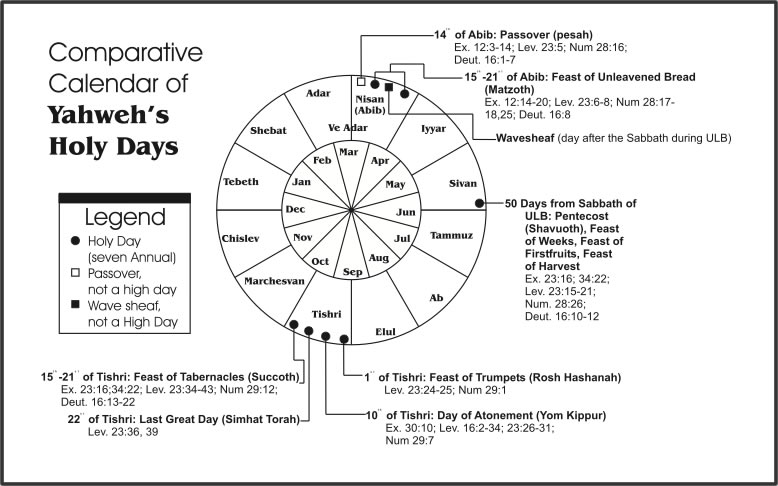
© 2007, 2018 Yahweh's Assembly in Yahshua
2963 County Road 233, Kingdom City, Missouri 65262
View us online at: www.YAIY.org
Call Toll Free: (877) 642-4101
Main Line : (573) 642-4100
2963 County Road 233, Kingdom City, Missouri 65262
View us online at: www.YAIY.org
Call Toll Free: (877) 642-4101
Main Line : (573) 642-4100
