


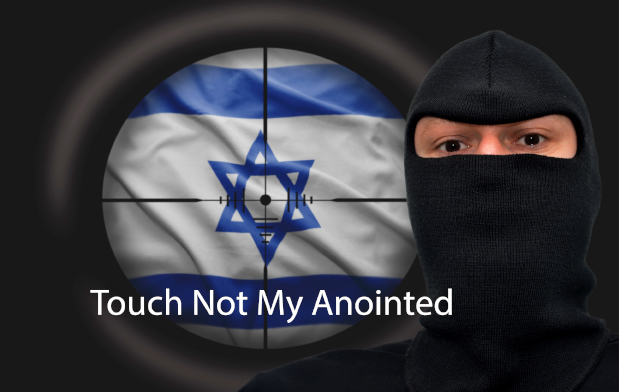
Throughout the Scriptures, we have many warnings and admonitions. Yet, one that in modern days seems especially overlooked is found in Psalms 105:15, Do not touch My anointed ones, and do My prophets no harm. And who are His anointed? And why does Yahweh warn people to inflict no harm upon His anointed?
Israel Chosen and Anointed
We learn from the Word of Yahweh who His anointed are – not necessarily a specific person, but an entire nation of people, like that people Israel … or as well, in these times, the Body of Messiah, upon whom Yahweh conferred blessings and protection. While all Israel was blessed and appointed and chosen by Yahweh, certain individuals within Israel were appointed a greater higher anointing and calling. And conduct levied against them also merited a commensurately higher punishment.
But for now, let’s appreciate Yahweh’s choosing Abraham as the father of many nations, and particularly, the father of Israel. In Genesis 12:1-3 we read,
Now Yahweh said to Abram, “Go from your country, and from your relatives and from your father’s house, to the land which I will show you; and I will make you into a great nation, and I will bless you, and make your name great; and you shall be a blessing; and I will bless those who bless you, and the one who curses you I will curse. And in you all the families of the earth will be blessed. (The New American Standard Bible used throughout, unless otherwise noted.)
So, in this promise, Yahweh tells Abraham that he will become a great nation (Israel) and that those who bless him (Israel) will be blessed and those who curse him (Israel) will be cursed. This is an immutable declaration in Scripture. Even when, for their disobedience to Yahweh and manifold trespass of His Covenant, Israel was taken into captivity and dispersed from the land given them by promise, they who would make of Israel to become a byword and a reproach ultimately suffered the consequence of Yahweh’s pronouncement of a curse upon them. But why is Yahweh so protective of Israel? What has Israel done that warrants such a blessing and protection? Nothing!
It was not because of anything Israel did that they warranted Yahweh’s favor. Rather, Yahweh Who cannot lie (Num 23:19), and Who for His Name’s sake, remained faithful to the covenant He had made with Abraham, Isaac, and Jacob and that, moreover, it was because of the grievous wickedness of the peoples in the lands which Israel was to possess that the others were dispossessed (Deut. 9:4-8, 10:15).
Indeed, Israel has always been rebellious and stiff-necked. Yet, Yahweh has not rescinded Israel’s calling as a light to the nations (Isa. 60:1-3) and their appointment as a royal priesthood (Exod.19:6).
Deuteronomy 14:2 reads, For you are a holy people to Yahweh your Elohim, and Yahweh has chosen you to be a people for His own possession out of all the peoples who are on the face of the earth. And 1 Peter 2:9 further says of those who have been reconciled to Yahweh through the blood atonement of Yahshua the Messiah and made to become a partaker in the commonwealth of Israel and the Covenants of promise, But you are a chosen race, a royal priesthood, a holy nation, a people for [Elohim’s] own possession, so that you may proclaim the excellencies of Him who has called you out of darkness into His marvelous light.
Israel was always purposed of Yahweh to be an obedient nation whose blessings would be the talk of the world (Deut. 4:5-8). Nevertheless, the condition of Israel continuing to be blessed is contingent upon their obedience, as it is written: Now it shall be, if you diligently obey Yahweh your Elohim, being careful to do all His commandments which I command you today, Yahweh your Elohim will set you high above all the nations of the earth, Deuteronomy 28:1.
Moreover, worthy of note is that Yahweh during the time of Israel’s duress in Egypt, calls Israel His firstborn in (Exod. 4:22), showing how highly He regards them. Another reason Israel is protected by Yahweh, is because through Abraham’s seed (Israel) all the nations of the earth will be blessed (Gen. 18:8) as it is further written, Yahweh says to Abraham, “And I will multiply your descendants as the stars of heaven, and will give your descendants all these lands; and by your descendants all the nations of the earth shall be blessed,” Genesis 26:4. Thus, Israel is destined to be a conduit of blessings for the whole world. So, when one curses Israel, they are cursing themselves. Despite all of Israel’s backslidings, however, Yahweh has not, and will not, forsake them utterly.
Thus says Yahweh, Who gives the sun for light by day and the fixed order of the moon and the stars for light by night, Who stirs up the sea so that its waves roar; Yahweh of hosts is His Name: “If this fixed order departs from before Me,” declares Yahweh, “Then the offspring of Israel also will cease from being a nation before Me forever.” Thus says Yahweh, “If the heavens above can be measured and the foundations of the earth searched out below, then I will also cast off all the offspring of Israel for all that they have done,” declares Yahweh, Jeremiah 31:35-37.
Now, the Matter of Ba’al Peor
This brings us to Balaam son of Beor whom Balak king of Moab engaged to curse Israel. (The narrative in Numbers, chapters 22-24, relates Balak’s enterprise in seeking to implore Yahweh’s disenfranchisement of Israel.) Moab was terrified with Israel’s having vanquished the Amorites, and feared for their own security, observing, “there is a people come out from Egypt: behold, they cover the face of the earth … Now shall this company lick up all that are round about us, as the ox licketh up the grass of the field” (Num. 22:5, 4, KJV).
And so, we read Balaam inquired of Yahweh. What Yahweh says in reply, confirms Israel’s esteemed position with Him.
Balaam said to Elohim, “Balak the son of Zippor, king of Moab, has sent word to me, ‘Behold, there is a people who came out of Egypt and they cover the surface of the land; now come, curse them for me; perhaps I may be able to fight against them and drive them out.’ ” Elohim said to Balaam, “Do not go with them; you shall not curse the people, for they are blessed,” Numbers 22: 10-12.
There is no higher Authority than Yahweh. Balaam had no power to curse Israel even if he had had a mind to do so. How could Balaam indeed curse what Yahweh had not cursed? (Num. 23:8). What Yahweh has blessed, man cannot revoke (Num. 23:20). Yahweh is not like man; He will not lie or repent concerning His blessings (Num. 23:19). The only thing that can annul Yahweh’s blessings is disobedience. Thus, Balaam instructed Balak to put a snare before Israel, so that Israel would bring a curse upon themselves through their sin, to eat things sacrificed to idols, and to commit acts of immorality (Rev. 2:14). For his error, Balaam received the just retribution of the sword (Num. 31:8).
We, Too, are Israel
One may wonder what does this have to do with us in the Body of Messiah? It matters, because we are Israel. By virtue of one’s immersion in water in the Name of Yahshua for the remission of his/her sins that are past, they are made partakers in the commonwealth of Israel, and heirs to the covenants of promise (Eph. 2:12). So,
If the first piece [of dough] (Israel) is holy, the lump is also; and if the root is holy, the branches are too. But if some of the branches were broken off, and you, being a wild olive, were grafted in among them and became partaker with them of the rich root of the olive tree, do not be arrogant toward the branches; but if you are arrogant, [remember that] it is not you who supports the root, but the root [supports] you. You will say then, “Branches were broken off so that I might be grafted in.” Quite right, they were broken off for their unbelief, but you stand by your faith. Do not be conceited, but fear; for if Elohim did not spare the natural branches, He will not spare you, either. Behold then the kindness and severity of Elohim; to those who fell, severity, but to you, Elohim’s kindness, if you continue in His kindness; otherwise, you also will be cut off. And they also, if they do not continue in their unbelief, will be grafted in, for Elohim is able to graft them in again. For if you were cut off from what is by nature a wild olive tree, and were grafted contrary to nature into a cultivated olive tree, how much more will these who are the natural [branches] be grafted into their own olive tree? Romans 11:16-24.
In Jeremiah 11:16, we read, “Yahweh called your name, ‘A green olive tree, beautiful in fruit and form’ …” The Apostle Paul uses the metaphor of an olive tree in making it clear that we are grafted into Israel when we come into this Faith.
Moreover, Paul affirms elsewhere, that in Messiah Yahshua, neither circumcision, nor uncircumcision, avails anything, but a new creature – the Israel of Elohim – upon whom is bestowed peace and mercy (Gal. 6:15-16) and which is further corroborated in the following passages from Romans 2:26-29:
If therefore the uncircumcised man keeps the requirements of the Law, will not his uncircumcision be regarded as circumcision? And will not he who is physically uncircumcised, if he keeps the Law, will he not judge you who though having the letter [of the Law] and circumcision are a transgressor of the Law? For he is not a Jew who is one outwardly; neither is circumcision that which is outward in the flesh. But he is a Jew who is one inwardly; and circumcision is that which of the heart, by the Spirit, not by the letter; and his praise is not from men, but of Elohim,
And Ephesians 2:11-14:
Therefore remember that formerly you, the Gentiles in the flesh, who are called “Uncircumcision” by the so-called “Circumcision,” [which is] performed in the flesh by human hands – [remember] that you were at that time separate from Messiah, excluded from the commonwealth of Israel, and strangers to the covenants of promise, having no hope and without Elohim in the world. But now in Messiah Yahshua you who formerly were far off have been brought near by the blood of Messiah. For He Himself is our peace, Who made both [groups into one] and broke down the barrier of the dividing wall.
So, we may rightly conclude from Scripture, that all those who are bought and washed by Yahshua’s blood, are Israelites by faith.
Why is this important? because the same blessings imputed to Israel apply as well, to us who are faithful. We are Israel, and those who take a stance against us risk a curse upon themselves.
Higher Anointings
Though we can appreciate Israel being a called out, chosen … even a peculiar, set apart people, there are some among Israel who are due a greater honor because their anointing is higher. Several persons in Scripture qualify. One is Moses, a prophet of Yahweh and held in higher regard by both man and Yahweh. His position, however, did not preclude the people of Israel from grumbling against him.
However, in the following passage in which the people murmur against Moses and Aaron, the anointed of Yahweh, Moses retorts that the peoples’ grumbling against the pair was really a complaint against Yahweh.
The whole congregation of the sons of Israel grumbled against Moses and Aaron in the wilderness. The sons of Israel said to them, “Would that we had died by Yahweh’s hand in the land of Egypt, when we sat by the pots of meat, when we ate bread to the full; for you have brought us out into this wilderness to kill this whole assembly with hunger. Then Yahweh said to Moses, “Behold, I will rain bread from heaven for you; and the people shall go out and gather a day’s portion every day, that I may test them, whether or not they will walk in My instruction. On the sixth day, when they prepare what they bring in, it will be twice as much as they gather daily.” So Moses and Aaron said to all the sons of Israel, “At evening you will know that Yahweh has brought you out of the land of Egypt; and in the morning you will see the glory of Yahweh, for He hears your grumblings against Yahweh; and what are we, that you grumble against us?” Moses said, “[This will happen] when Yahweh gives you meat to eat in the evening, and bread to the full in the morning; for Yahweh hears your grumblings which you grumble against Him. And what are we? Your grumblings are not against us but against Yahweh, Exodus 16:2-8.
Speaking against Yahweh’s anointed or against His prophets is no different from challenging Yahweh Himself.
In other places of the Torah narrative, we read of Yahweh taking the side of Moses whenever his authority was questioned. In Numbers 12:6-8, for example, Yahweh chides Aaron and Miriam for their boldly challenging the special anointing Yahweh had conferred upon their brother, saying,
“Hear now My words: If there is a prophet among you, I, Yahweh, shall make Myself known to him in a vision. I shall speak with him in a dream. Not so, with My servant Moses, he is faithful in all My household; with him I speak mouth to mouth, even openly, and not in dark sayings and he beholds the form of Yahweh. Why then were you not afraid to speak against My servant, against Moses?”
Like Aaron and Miriam before them, Korah, Dathan, Abiram, and On, together with two hundred and fifty leaders of the congregation rose up against Moses and Aaron, protesting, “You have gone far enough, for all the congregation are holy, every one of them, and Yahweh is in their midst; so why do you exalt yourselves above the assembly of Yahweh” (Num. 16:1-3).
Indeed, Korah spoke the truth when he acknowledged that the whole congregation was set apart. But he failed to understand and respect the higher anointing conferred upon Moses. A further read of the narrative reveals that Korah’s incitation to riot did not end well for him and his companions, as Yahweh avenged their rebellion by making a new thing: the ground opening its mouth and swallowing them up alive with all that was theirs (Num. 16:30-31) and fire also, come forth to consume the two hundred and fifty men complicit with Korah and who had presumed the office of the priests in burning incense (Num. 16:35).
Having either witnessed or heard of Yahweh’s displeasure in these instances, the people who entered into Canaan under Joshua’s authority, were careful not to repeat Korah’s error lest they incur to themselves that recompense of falling into the hands of Living, Consuming Fire … pledging themselves, saying,
“All that you have commanded us we will do, and wherever you send us we will go. … only may Yahweh your Elohim be with you as He was with Moses. Anyone who rebels against your command and does not obey your words in all that you command him, shall be put to death; only be strong and courageous” (Josh. 1:16, 17, 18).
So, what we should learn from Israel’s wilderness experiences is that Yahweh does not take kindly to any who carelessly speaks against those whom He has anointed including now, the called-out ones which comprise the Body of Messiah.
Moreover, in the New Testament record, the Apostle Paul asserts double honor should be accorded the elders in the Assembly, saying, The elders who lead well are to be considered worthy of double honor, especially those who work hard at preaching and teaching, 1 Timothy 5:17.
David and Saul Contrasted
Both Saul and David were anointed as kings over Israel by the Prophet Samuel. While Saul is noted in 1 Samuel 10:9 as having his heart changed by Yahweh on the day of his anointing, his presuming the office of the priests in offering to Yahweh a burnt offering before engaging the Philistines in battle (1 Sam. 13:12) and subsequent disobedience in the matter of extirpating all the Amalekites, including Agag (1 Sam. 15), and envy – one of the seven capital sins – as all the maidens acclaimed David for his slaying the giant (1 Sam. 18:7), he tarnished that anointing with his indiscretions … not the least of which, was his rending Samuel’s garment when the seer declined to accompany him in worshipping Yahweh and Samuel declared, “Yahweh has torn the kingdom of Israel from you today, and has given it to your neighbor who is better than you” (1 Sam. 15:25-27).
David, on the other hand, sought to remain loyally subject to Saul, now mad with jealousy, even during those times when Saul abandoned the affairs of state to pursue him. And when David had opportunity, and was encouraged, to advantage himself with Saul’s death, he refused to lift his hand against Yahweh’s anointed one, even at the risk of his life as he emerged from the cave of Engedi, attesting to his conviction, “Behold, this day your eye have seen that Yahweh had given you today into my hand in the cave, and some said to kill you, but my eye had pity on you; and I said, ‘I will not stretch out my hand against my lord, for he is Yahweh’s anointed’ ” (1 Sam. 24:10)
A second time, David might have availed himself opportunity as Saul lay asleep while encamped in the hill of Hachilah during one of his many pursuits of the shepherd from Bethlehem and again, was pressed by Abishai to permit him to slay the king (1 Sam. 26:8). But David said to Abishai, “Do not destroy him, for who can stretch out his hand against Yahweh’s anointed and be without guilt … Yahweh forbid that I should stretch out my hand against Yahweh’s anointed …’ ” (1 Sam. 26:9, 11).
David so much regarded Yahweh’s anointing as sacred, that when a young Amalekite had come to David’s camp and represented himself as having slain Saul,
“David took hold of his clothes and tore them, and so also did all the men who were with him … Then David said to him, ‘How is it you were not afraid to stretch out your hand to destroy Yahweh’s anointed’? And David called one of the young men and said, ‘Go, cut him down’. So he struck him and he died. And David said to him, ‘Your blood is on your head, for your mouth has testified against you, saying, ‘I have killed Yahweh’s anointed’ ” (2 Sam. 1:11, 14-16).
Conclusion
Do not be deceived, Yahweh is not mocked; for whatever a person sows, this he will also reap, Galatians 6:7. One should not think he can touch Yahweh’s anointed or chosen ones, or do his prophets harm, with impunity. Better, far better, He should heed the words of the psalmist: Do not touch My anointed ones, and do not harm My prophets, Psalm 105:15.
- Deacon Lucas Bentley
© 2026 Yahweh's Assembly in Yahshua
2963 County Road 233, Kingdom City, Missouri 65262
View us online at: www.YAIY.org
Call Toll Free: (877) 642-4101
Main Line : (573) 642-4100
2963 County Road 233, Kingdom City, Missouri 65262
View us online at: www.YAIY.org
Call Toll Free: (877) 642-4101
Main Line : (573) 642-4100
